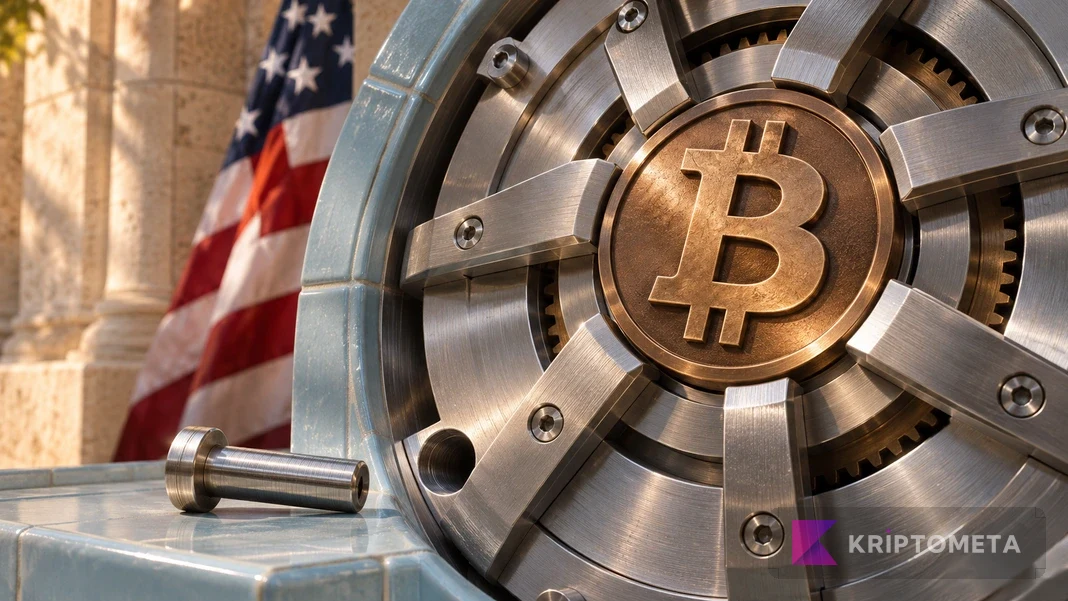
A bill placed on the House calendar proposes holding federal reserve Bitcoin for at least 20 years. Additional purchases would be studied separately, with no fixed buying mandate.
A US bill that would require the federal government to retain its Bitcoin holdings moved onto the House’s Union Calendar on November 24. H.R. 8957, reported by the Financial Services Committee with amendments, proposes a minimum 20-year holding period for BTC in a Strategic Bitcoin Reserve. The proposed sales ban has not become law.
The official congressional record shows that the committee voted 28–21 to report the bill on September 16. The report was submitted and the bill placed on the Union Calendar, number 789, on November 24. That list makes the legislation available for House consideration. The record shows neither an announced floor-vote date nor passage by the House.
Introduced by Alaska Representative Nick Begich, the American Reserve Modernization Act of 2026 would create two arrangements: a strategic reserve for Bitcoin and a separate stockpile for other qualifying digital assets. The reported text proposes mandatory custody rules for existing BTC while asking officials to study the costs of further acquisitions.
The 20-year clock starts at enactment, not at each deposit
Section 5 measures the minimum holding period from the date the legislation becomes law. Later deposits would not restart the period for each batch of Bitcoin. During that period, the Treasury could not sell, swap, auction, encumber or otherwise dispose of Bitcoin in the reserve.
Two years before the period ends, the Treasury would have to recommend to Congress whether to keep holding the assets or allow a controlled release. After the minimum period expires, it could recommend selling up to 10% of the reserve during any two-year period. That percentage is neither a current sale instruction nor an automatic disposal schedule.
A separate provision calls for a study within one year on circumstances that might justify earlier sales. It would include legislative recommendations for exceptions involving national security or financial stability. The Treasury could not lift the 20-year restriction simply by completing that study.
Before selling, the Treasury would have to establish rules. It would also disclose how the sale schedule and maximum quantity would be determined. It would be required to act transparently and minimize market disruption.
Which assets would move to the Treasury?
The reserve would cover Bitcoin owned by the federal government and not legally required for another purpose. That can include BTC finally forfeited in criminal or civil proceedings, or obtained in satisfaction of civil monetary penalties. Assets temporarily seized during an investigation would not automatically become reserve property.
Federal agencies would list all Bitcoin and other digital assets they hold, have seized or otherwise control. Only assets owned by the government and not required for another legal purpose would qualify for transfer. Assets needed for victim restitution or other legal obligations would be set aside under the applicable requirements.
- Within 60 days of enactment, agencies would provide their first complete inventory, followed by annual updates.
- The Treasury would establish the Bitcoin reserve and separate digital asset stockpile within 180 days.
- Qualifying assets would move into those arrangements within 30 days of establishment, with auditable transfer records.
- The first status and audit report would go to the relevant congressional committees within 360 days of establishment, followed by annual reports.
Qualifying assets held in temporary custody before the reserve is established would also face restrictions on sales and swaps. That transitional provision contains exceptions for national security, legal requirements, court orders and restitution to victims. It is separate from the proposed 20-year holding rule for reserve Bitcoin.
Centralizing custody is part of the supporters’ case. In remarks shared by the committee in a September 16 post, Representative Bryan Steil argued that fragmented custody creates cybersecurity risks and makes it harder to account for what the government owns. The linked video comes from the September committee consideration; it is not a new speech delivered on November 24.
A study on purchases and public evidence of custody
The Treasury and Commerce departments would have 180 days from enactment to study the costs and risks of additional Bitcoin acquisitions and submit a joint report. They would examine sales or swaps of other stockpiled digital assets, BTC obtained through forfeitures and settlements, and cooperation with states and private organizations. Officials would calculate the full costs and benefits, including whether acquisitions could avoid increasing the national debt in nominal or economic terms.
That section does not authorize borrowing, pledging public assets as collateral, new taxation or deficit spending to buy Bitcoin. The text specifies no purchase quantity, market order or first-buy date. The House calendar entry gives no basis for treating the proposal as government purchases taking place today.
The Treasury would also establish a public proof-of-reserves system. Annual reporting would cover holdings, transactions and control of the associated private keys. The Treasury would have to prove it controls the keys without publishing the secrets themselves. An independent third party with cryptographic expertise would verify the annual report, while the Comptroller General would oversee the reserve, reports and audits.
State participation would be voluntary. Under a program to be established within one year, states could hold Bitcoin in segregated accounts while retaining title to it. Written agreements would set security standards, responsibilities and fees. States would retain withdrawal rights subject to those agreements and federal rules. States would also have to acknowledge that custody risks cannot be eliminated and that they assume those risks.
The final section expressly provides no authority to confiscate lawfully acquired private Bitcoin holdings. It preserves individuals’ rights to self-custody and control of their keys.