










Before buying an NFT, look beyond the artwork and its price tag. A matching contract, clear usage rights and understandable wallet permissions provide a firmer basis for the decision.
The same artwork can appear under several collection names. Even a polished marketplace listing may leave the rights attached to a token unclear. Checking an NFT before buying it means establishing what you are paying for and what you are authorizing. The seven steps below address those practical questions rather than predicting resale prices.
The technical examples use Ethereum and ERC-721. Other networks have different standards and tools. Showing a collection does not recommend buying it, and completing every check cannot eliminate price losses or software defects.
1. Reach the collection through an independent route
Avoid starting from a search advertisement, unsolicited direct message or supposed support account. Compare the project's established web address, announcement channels and published contract. Several accounts copying the same link do not constitute independent verification.
Collection names and profile images can be copied. A verification badge cannot guarantee future returns or secure code. If the relationship between the project's official domain and the listed collection cannot be established, stop before proceeding to checkout.
2. Match the network, contract address and token ID
An ERC-721 NFT requires three identifiers together: the network, collection contract and token ID. The ERC-721 standard tracks ownership by token identity. Different contracts can reuse the same number, so “NFT number 42” does not uniquely identify the asset.
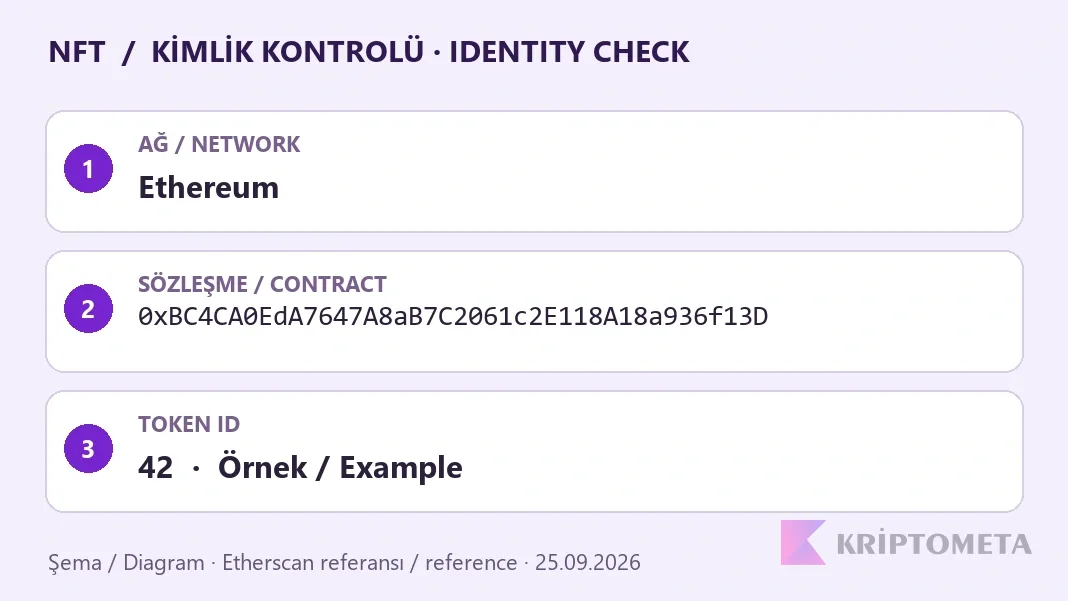
The BAYC contract page we opened showed the address beside Contract and a separate Token Tracker link to the collection. The actual contract screen helps establish contract identity; the listing's token ID must then match that same contract. We did not connect a wallet, make a purchase or perform a security audit.
Compare the complete address against a trusted reference, rather than just its opening and closing characters. Our Etherscan review explains the distinction between contract records and transaction records if those screens are unfamiliar.
3. Read the rights you are purchasing
Token ownership is separate from copyright in the artwork. Displaying an image as an avatar, using it in an advertisement and selling printed merchandise can require different permissions. Commercial-use limits, transfer conditions and whether license terms can change should be explicit.
The US Copyright Office and USPTO's 2024 NFT study highlighted confusion about intellectual property rights. That US study does not determine the legal outcome of every purchase worldwide. The practical task is to retain the applicable license and avoid assuming that an unspecified right has been granted.
For game items or memberships, check what remains if the service closes. A token can remain on-chain even after the game servers or membership benefits cease operating.
4. Find out where the artwork and metadata live
Metadata may hold a token's name, description and image link. If the contract's tokenURI points to an external file, access to that file is a separate dependency. The existence of an on-chain NFT does not mean every byte of its artwork is stored on-chain.
IPFS's NFT data guidance distinguishes a content-addressed IPFS reference from an HTTP gateway URL. A CID identifies content; continued storage and pinning support availability. A gateway working today is not a promise of permanent hosting.
Can the metadata change, who has that authority, and how will the media remain available? Missing answers should not be replaced with assumptions about permanent artwork or continuing service.
5. Separate the asking price from the total cost
Network fees and buyer-side marketplace charges can add to the sale price. Creator royalties and seller commissions may matter when reselling. Do not count a fee twice if it is already included in the displayed total; use the breakdown on the confirmation screen.
| Item | Illustrative amount |
|---|---|
| NFT sale price | 0.05 ETH |
| Assumed network fee | 0.001 ETH |
| Other buyer charges | Assumed absent |
| Total | 0.051 ETH |
Here the network fee adds 2% of the sale price. Actual gas costs vary. At a purely hypothetical ETH price of $2,000, the total would equal $102, not $100. Our gas fee calculator helps explain the cost; recheck the network, transaction and quoted fee in the wallet before signing. Exchange withdrawals or bridging may add separate charges.
6. Understand what the wallet is signing
Connecting a wallet, signing a login message, signing a sale order and authorizing an operator are different actions. A signature without a network fee can still have consequences. In particular, setApprovalForAll can authorize an operator over your NFTs in the relevant contract, rather than just the token currently on screen.
If the recipient, scope or duration of a permission is unclear, do not sign. A marketplace does not need your seed phrase or private key to process a purchase. Afterwards, use the method in our token approval revocation guide to review unnecessary permissions. Revoking an approval does not recover assets that have already been taken.
7. Write down your exit assumptions and reasons to stop
A high listing price does not establish a future buyer. Completed sales, executable bids and trading frequency answer different questions. Our NFT market analysis compares volume with independent buyer demand through worked examples. Repeated transactions among the same controlled wallets should not be treated as independent demand.
Assess gaps between the team's identity, development promises and use of funds. Collecting money and abandoning the project can raise rug-pull concerns; a price decline alone does not establish fraud. You do not need to wait for a falling price to reject a mismatched contract, an unclear license or an unexplained signature request.
Keep a short decision record with the network, full contract address, token ID, license date, storage arrangement, total cost and permissions granted. It provides a record of what you bought months later and separates enthusiasm for the artwork from acceptance of its risks.