













A quoted amount is only part of a swap. An actual Uniswap screen and a worked cost comparison show what to check before signing and how to confirm what arrived.
Swapping tokens on a decentralized exchange (DEX) means exchanging an asset from your wallet through smart contracts. The key task is checking what you will receive, on which network, and under which conditions. A familiar ticker or polished quote screen cannot establish that the token contract is genuine.
This guide covers same-network spot swaps. Bridging, leveraged positions and providing liquidity are different workflows. We used official Uniswap documentation and observed its public interface on September 28, 2026, without connecting a wallet or signing a transaction. The captured quote is a dated illustration, not an executable price or a trade recommendation.
1. Match the network and both token contracts
Start with the network on which your selling asset is actually held. Find the receiving token’s official contract for that network in the project’s own documentation. Names and icons can be copied. Tokens with the same ticker on Ethereum and another network need not be the same contract or have the same redemption rights.
Reach the application through an independently verified official website. Avoid treating a sponsored search result or private message as proof of authenticity. Connecting a wallet does not require entering its recovery phrase; Ethereum’s security guidance explains why those secrets must stay private. Our fake-token and phishing checklist covers the checks before an interaction.
If the network icons differ between the input and output asset, stop and identify the route. Some interfaces offer cross-chain swaps in the same form. Such a quote may involve a bridge, additional contracts and a separate settlement period. Do not assess it as an ordinary same-chain exchange.
2. Set the input and leave room for network fees
Enter a deliberate amount rather than starting with the maximum balance. For a standard ERC-20 swap on Ethereum, you may need ETH in addition to the token you are selling. Using all available native currency can leave too little for the approval or the swap itself.
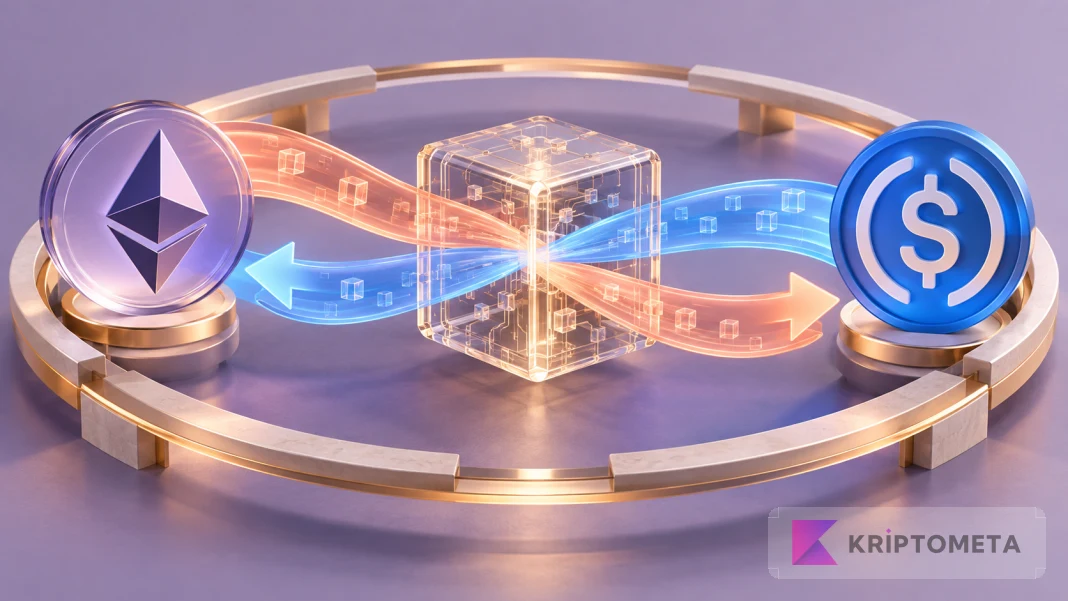
Uniswap’s documented swap flow runs from selecting assets to checking the completed transaction. In the actual screen below, the upper field is ETH offered and the lower field is the estimated USDC received. No wallet was connected, so the screen does not show a completed purchase.

Uniswap web interface captured September 28, 2026. A quote for 0.1 ETH, viewed without connecting a wallet or submitting a transaction. Quotes, routes and interface labels can change.
3. Read four separate parts of the quote
The largest number in the form is not the whole decision. Estimated output, minimum output, price impact and fees describe different things. Price impact concerns the change caused by your own trade relative to available liquidity. Slippage concerns a change between the quote and execution.
| Field | Question it answers |
|---|---|
| Estimated output | What does the selected route offer now? |
| Minimum output | Below which output amount should this transaction not execute? |
| Price impact | How large is my trade relative to liquidity? |
| Fees | Which costs are included, and which require additional funds? |
Increasing slippage tolerance does not deepen a pool or repair a poor quote. It permits a wider change. Do not bypass a high-impact warning simply to complete the transaction. Comparing a smaller input can reveal the effect of trade size, although splitting a trade may increase total network costs.
Worked example: identical output, different cost
Suppose two hypothetical quotes offer 0.400 ETH for 1,000 USDC, with both previews displaying a minimum output of 0.398 ETH. That minimum is not a fee of 0.002 ETH and does not mean the entire difference will be lost. Read the actual transaction preview instead of calculating a boundary from a percentage by habit.
Assume route A requires $2 in combined approval and swap network costs, while route B requires $8. The additional cost is $6, or 0.6% of a hypothetical $1,000 starting value. USDC is valued at $1 only to keep the arithmetic simple; its market value must be checked in a real comparison. Token-price movement, transfer taxes and a later exit transaction are excluded.
Check whether an interface fee has already been deducted from the displayed output. Subtracting it again would overstate the cost. A gas fee calculator can help frame the network-cost estimate, but the wallet’s transaction preview and eventual receipt establish what was charged.
4. Separate spending permission from the swap
An approval authorizes a specified contract to use a token. After a successful approval, your wallet may still hold the original asset. The swap transaction or order signature can be another step. Selling native ETH does not necessarily require the same ERC-20 approval sequence.
Read the spender, token, limit and any expiration in the wallet. A permission message may have no network fee while still granting meaningful authority. Question a limit much larger than the intended transaction. The token approval review and revocation guide covers permissions you may want to revisit later.
Do not sign a request that differs from the amount or authority you expected. A refreshed quote can change the minimum output and costs. The route may change the number or names of steps; it should not remove your ability to understand the assets and permissions involved.
5. Verify the onchain result
Submitted, pending and successful are different states. A wallet window closing is not a receipt. Inspect the transaction on the correct network and compare its status, input token, output amount, recipient and network fee. The transaction-ID tracking guide explains how to read those records.
If a successful swap does not appear in the wallet’s token list, verify the network and contract before adding the token to the display. A failed onchain transaction can still consume gas. Check the failure reason before repeatedly resubmitting: changed quotes, insufficient liquidity and token restrictions require different responses.
Know when to leave the swap unfinished
An unverifiable contract, unexplained transfer deduction, unexpected permission or unacceptable minimum output is a reason to stop. A small successful test does not prove that a token will remain sellable. For the application’s particular controls and limitations, see our Uniswap interface review. Exchanging assets and depositing them into a liquidity position remain separate decisions.

