












For U.S. readers, the relevant comparison is the eligible product and its total cost. Coinbase and Kraken each have different order-book and simple-buy pricing models.
Crypto exchange fees are hard to compare when the products do different jobs. An instant-buy quote and an order-book maker rate are not equivalent prices. Even within one brand, commission, execution price, payment method and withdrawal charges can change what you finally receive.
We reviewed official pricing and help pages on September 28, 2026. This English comparison focuses on Coinbase and Kraken products for a U.S. reader, subject to state, account and asset eligibility. We did not open accounts, deposit money or execute trades. Binance Global is not a U.S. alternative; its international fee table and Binance TR are outside this version’s comparison. Our broader U.S. crypto exchange comparison covers platform selection.
Compare products before comparing percentages
Order-book spot trading, instant buying, conversion and derivatives have different pricing. Choose the same asset, quantity, observation time and exit route. Keep USD funding separate from a stablecoin route that may require another conversion. A dollar-denominated quote does not make every payment or withdrawal channel equivalent.
| Product | Published structure | What still needs checking |
|---|---|---|
| Kraken Pro Spot Crypto | Tier 1: 0.40% maker / 0.80% taker | Account tier, market and any special-pair schedule |
| Kraken Instant Buy/Sell | Separate trade/payment fees and a quoted spread | Final preview; Pro rates do not apply automatically |
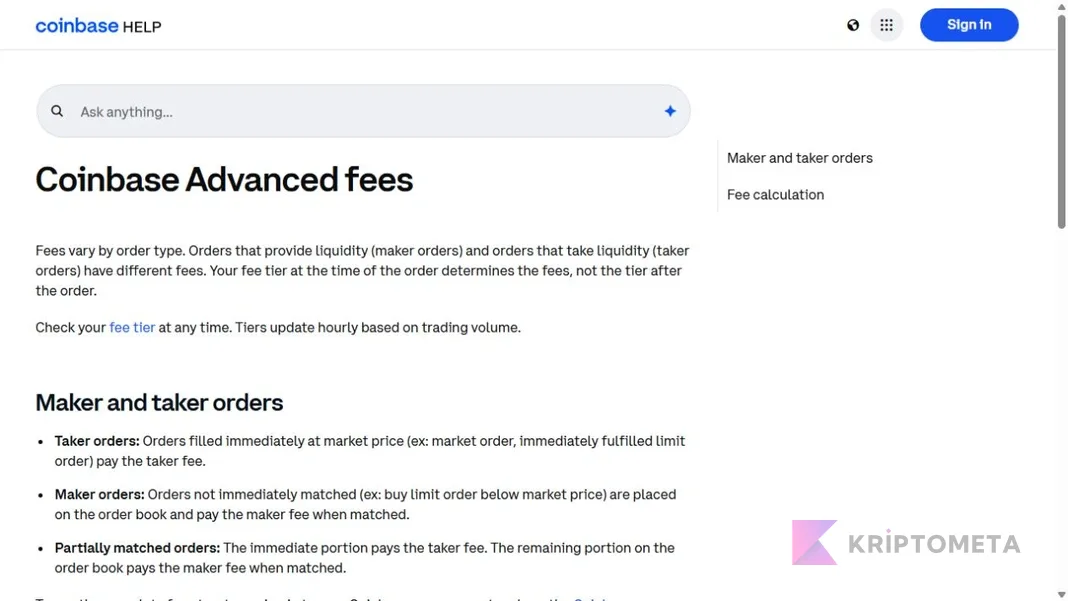
| Coinbase Advanced | Maker/taker pricing; official help directs users to the signed-in fee tier | The account’s current rate and order preview |
| Coinbase simple Trade | Quoted price can include spread alongside applicable fees | Payment method, transaction and disclosed price breakdown |
Kraken Pro: use the current schedule, not a remembered rate
The official Spot Crypto fee table displayed 0.40% maker and 0.80% taker for the first tier. An older 0.25%/ 0.40% pair is not a substitute for that current entry tier. Nor should a special-market promotion or Instant Buy price be substituted for the Pro schedule.
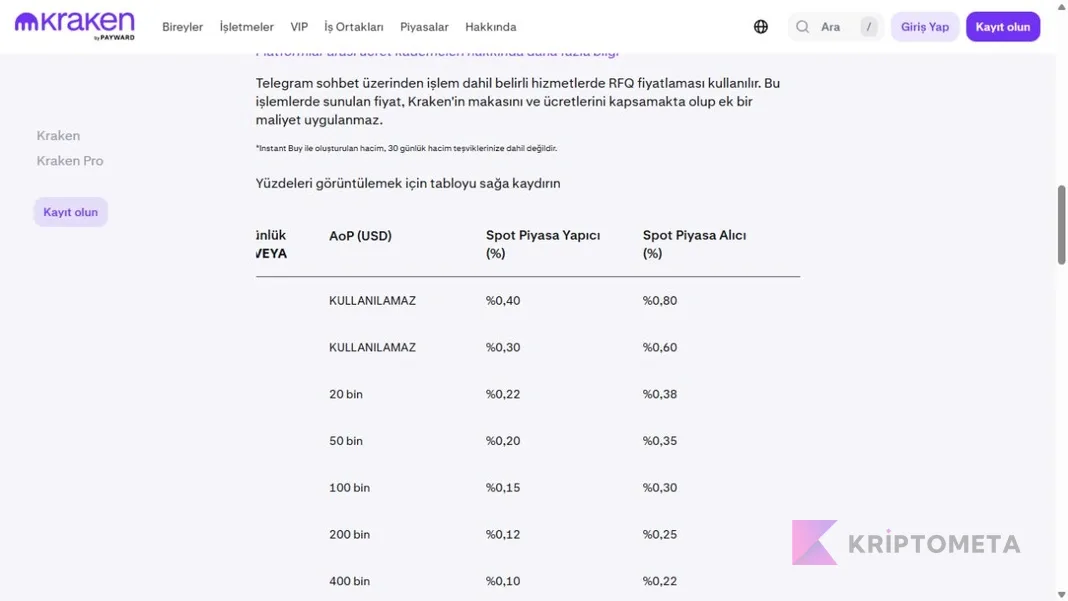
Kraken’s tier rules can take account of spot/futures volume and assets held on the platform. Trading merely to qualify for a lower rate creates additional costs and market exposure. The Kraken Pro review covers its order controls; the focus here is how the tariff changes a cost calculation.
Coinbase Advanced is not simple Trade
Coinbase’s Advanced fee guidance makes the tier at order time relevant and directs users to their account for the complete schedule. We did not copy an unverified universal starting rate from an older comparison.
The pricing disclosure describes spread in simple Trade quotes and direct order-book interaction on Advanced. No added quote spread on Advanced does not mean the market’s bid–ask spread or execution slippage is zero. Our Coinbase review separates account access, funding and product limits.
A limit order can pay taker fees
Maker and taker describe how a fill interacts with liquidity. A portion that rests in the book may be a maker fill; a portion that immediately matches an existing offer is a taker fill. One limit order can have both. Where supported, post-only settings can reject or cancel an order that would match immediately. They do not guarantee that a resting order will eventually execute.
Using the dated Kraken Tier 1 rates, suppose a hypothetical $1,000 order fills $400 immediately and another $600 after resting. The commission is $400 × 0.008 + $600 × 0.004 = $5.60. Applying the maker rate to the entire limit order would produce $4, understating the fee by $1.60. Real calculations must use the account’s applicable market rate and actual fills.
The useful comparison: assets received for the same budget
Commission, the bid–ask spread and slippage are different concepts. A contemporaneous midpoint can serve as a reference for comparing average execution prices. If your calculation already uses the executed price, do not add the spread embedded in that price a second time.
Consider two fictional offers, with a $1,000 total budget and commission deducted from that budget. There are no funding or withdrawal charges in this simplified example. Offer A charges 0.10% with an execution price of $100.20 per unit. Offer B charges 0.30% with a price of $99.80.
| Offer | Available for purchase | Units received | Effective unit cost |
|---|---|---|---|
| A | $999 | 999 / 100.20 ≈ 9.97006 | 1,000 / 9.97006 ≈ $100.30 |
| B | $997 | 997 / 99.80 ≈ 9.98998 | 1,000 / 9.98998 ≈ $100.10 |
Offer B buys more units despite its higher commission because its execution price is better. A and B are not real exchanges, and higher fees are not inherently better. The example demonstrates why a headline percentage cannot settle the comparison. If a withdrawal fee is deducted in the asset, subtract it from units received. If your bank charges another dollar fee, include it in total outlay.
Small withdrawals can change the result
A fixed $5 withdrawal cost would equal 5% of a $100 purchase but 0.5% of a $1,000 purchase, before trading costs. Those amounts are illustrative, not a provider’s current tariff. Percentage-only comparisons miss the effect of fixed charges on smaller transfers.
Check the asset, network and minimum withdrawal amount at both ends. A cheaper network is not useful if the destination does not support it. The exchange’s withdrawal charge need not equal a blockchain’s live transaction fee. Use the final withdrawal preview, including any separate processing charge. Our Ethereum gas calculator estimates an on-chain cost, not an exchange withdrawal tariff. An order-book spot fill also need not be an individual on-chain transaction charged to you.
When a subscription changes the arithmetic
A zero-commission subscription can leave quoted spread, payment costs and the subscription price intact. Suppose a fictional $20 monthly plan waives a 0.5% trading fee and nothing else changes. Its simple break-even eligible volume is 20 / 0.005 = $4,000. Product exclusions, caps or a different execution price change that calculation.
The threshold is a way to assess an existing pattern of use, not a reason to trade more. Compare only transactions actually eligible for the benefit. A retail subscription should not be assumed to waive Advanced or Pro order-book fees unless its current terms explicitly say so.
Which workflow makes the cost easier to understand?
An occasional buyer may find an all-in preview easier to read, but still needs to compare the quoted execution price. An order-book user gets more control over price and order behavior, along with the need to monitor waiting and partial fills. The smallest maker rate does not choose the right workflow for every person.
Record the product, state/account eligibility, pair, tier, average fill price, fee currency and net amount after withdrawal together. That produces an auditable comparison for your transaction instead of an unsupported universal cheapest-exchange claim. Recheck dated tariffs when they change.