









This Pinata review examines public-file retention, gateway access and usage costs together. Official screens, an illustrative traffic bill and a migration checklist help assess the fit.
Uploading an NFT image to IPFS does not by itself ensure that the image will open next month. Retention, browser access and the cost of repeated views are separate jobs. Pinata's proposition is to turn those jobs into a managed service. Before choosing storage capacity, decide whether the files should be public or private.
This review uses Pinata's official pricing screen and documentation checked on 2 November 2026. KriptoMeta inspected publicly accessible material; we did not create an account, upload files, buy a paid plan or benchmark speed and uptime. The assessment covers documented capabilities and an illustrative cost calculation.
What does Pinata handle?
Pinata provides file storage and delivery services. IPFS is the protocol behind content addressing and sharing. Separating provider from protocol helps identify what must move if a project changes services.
The workflow adds a file, obtains its content identifier and lets an application display the corresponding data. Pinning concerns retention; a gateway concerns delivery to visitors. A managed service can reduce operational work for a team that does not want to maintain its own node and delivery infrastructure. The trade-off is operating within the provider's quotas and service conditions.
Public files are not private files with an obscure address
Content published to public IPFS can be retrieved from reachable copies by people who know its identifier. Restricting one web endpoint does not prevent another route from serving the same file. An unadvertised address is not sufficient protection for identity documents, customer records or confidential contracts.
Pinata's current documentation places Private IPFS on the Enterprise plan. Private files are not announced to the public IPFS network and can be served through temporary access links. Expiration cannot recall a copy already downloaded. Permission to retrieve a file and control over a recipient's copy are different questions.
| Requirement | Start by assessing | Avoid assuming |
|---|---|---|
| A public NFT image | Public IPFS, retention and delivery | The NFT guarantees permanent availability of the image |
| A file for authorized recipients | Private storage, permissions and expiring access | A gateway key makes public IPFS content confidential |
| Information that must be fully removable | Copy, backup and deletion policies | A dashboard deletion erases every internet copy |
Actual pricing screen: Traffic matters as much as storage
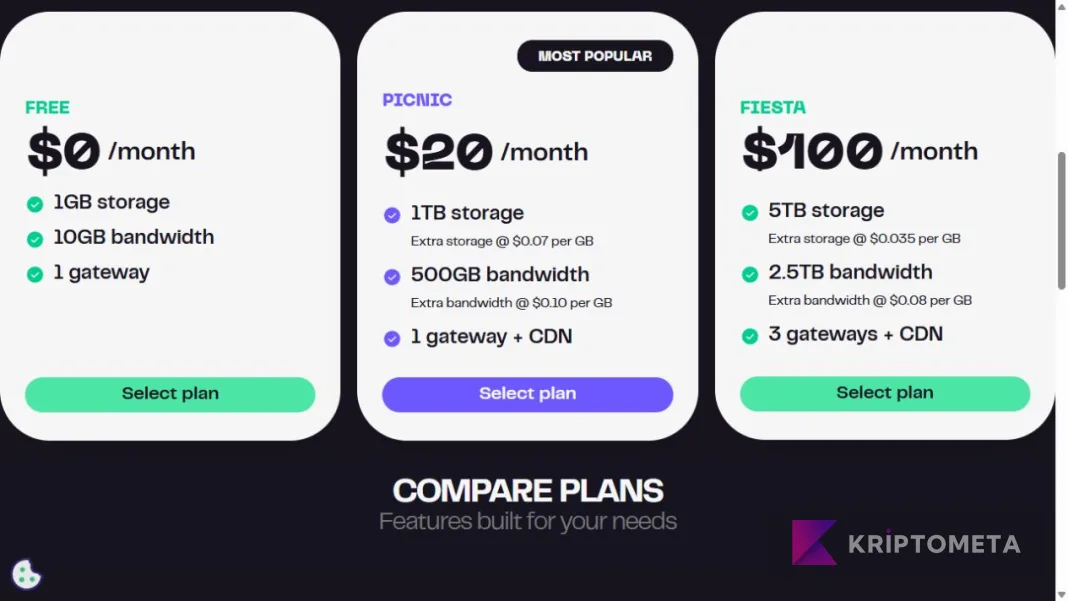
Screenshot of Pinata's public pricing page, taken on 2 November 2026. Monthly USD pricing; provider terms may change.
| Plan | Base price | Storage | Data transfer |
|---|---|---|---|
| Free | $0 | 1 GB | 10 GB |
| Picnic | $20 | 1 TB | 500 GB |
| Fiesta | $100 | 5 TB | 2.5 TB |
Other limits, including file and request counts, also apply. Storage allowance alone is not a complete capacity assessment. Taxes, additional services and usage overages can make the final bill differ from the base price.
Worked example: A small archive with many views
One hundred images at 2 MB each occupy only 200 MB. If they receive a combined 100,000 full downloads, the illustrative transfer total is 200 GB before caching or optimization effects. The files fit within free storage; the transfer exceeds that plan's 10 GB allowance.
At the review date, Picnic's additional transfer rate is $0.10/GB. A month with 600 GB of billable transfer would therefore cost $20 + (600 − 500) × $0.10 = $30, assuming no other allowance is exceeded. This excludes taxes and optional services. It is arithmetic, not measured application usage or a cache benchmark.
Estimate file size, full downloads and request count separately before launch. Compressing images and avoiding unnecessary repeated requests may help more than buying additional storage. An actual production decision should use measured account consumption.
What does a gateway address change?

URL diagram from Pinata's official documentation. The domain identifies the delivery service; the final part identifies content. It is not evidence of an upload test.
An IPFS gateway delivers content to an ordinary browser. Pinata's dedicated gateway defaults to content pinned in the account, with access controls available to manage its behavior. A custom domain can organize the visitor-facing address, but does not itself solve storage, quota or continuity problems.
The CID at the end identifies content, while the provider domain can change. If an application stores identity only inside a provider-specific URL, migration becomes harder. Keep the CID, original file and relevant import settings separately for a more portable arrangement.
Deleting files and moving providers
Removing a public file from a Pinata account unpins it there. Other nodes or caches may retain copies. A dashboard's deletion confirmation should not be interpreted as erasure of every copy.
Migration can require more than exporting file URLs. Grouping information, custom domains, access rules and provider-specific application settings need their own inventory. The following is a practical verification sequence, not a migration we performed:
- Back up original files, the CID list and the mapping between them.
- Verify that the destination retains the intended content and serves it under the correct CID.
- Check the application's new retrieval path, error handling and permissions where relevant.
- Reduce or close the original service only after the replacement copies and links work.
For NFT publishing, check the marketplace display, metadata and underlying file reference separately. Our pre-purchase NFT checks place storage information alongside the buyer’s other verification tasks. Our OpenSea review covers the marketplace side of that workflow; it does not replace a storage-provider assessment.
Strengths, limits and the right user
| Area | Useful capability | Associated limit |
|---|---|---|
| Operational work | Managing retention and delivery through one service | Dependence on provider plans and operations |
| Content identity | Building around portable CIDs | Account settings and all metadata do not transfer automatically |
| Getting started | A free plan for small public-file experiments | Heavy traffic and private files require different budgets |
| Access controls | Gateway and private-file options | They cannot conceal other copies of public IPFS content |
Pinata is worth assessing for small teams delivering public content without maintaining their own IPFS infrastructure. Confidential data, strict erasure requirements or high traffic call for an access and total-cost review first. Secret account credentials should stay out of client-side browser code.
KriptoMeta's judgment: Pinata's value extends beyond making uploads convenient to organizing retention and delivery. Its clearest fit is a public-content workload that matches the service's limits. We make no comparative claims about speed, uptime or security performance that we have not measured.
For public archives intended to remain unchanged, compare the payment model too. Our Arweave analysis examines upfront funding and future retention obligations, without treating it as the same product as managed IPFS.