









A reward rate does not describe the obligations attached to collateral. Read the operator view, contract terms and exit economics together before comparing restaking offers.
Restaking risks extend beyond a falling reward rate. When collateral secures additional services, failures in other software or operations can reach the depositor. Before comparing returns, identify whose actions could reduce which part of your position.
The six checks below use official EigenLayer documentation and its public operator interface observed on 2 November 2026. We did not connect a wallet, deposit assets or test reward performance. The worked calculation is hypothetical, not a current offer or a forecast.
1. Map the collateral path
Restaking commits collateral to additional security duties. Depositing an LST in an ordinary lending pool is not automatically restaking. EigenLayer connects restakers, operators and services; buying EIGEN alone is not the same as entering a particular restaking position.
Record three things: the asset deposited, the token or accounting claim received, and the asset requested on exit. Native ETH, an LST and a liquid restaking product do not follow identical paths. Identify the custody contract and its upgrade authority. If the network and contract address cannot be verified, an APR comparison is premature.
Our solo versus liquid staking comparison covers the earlier decision about basic staking. The question here is the additional obligation attached to the position, not another ranking of staking providers.
2. Examine allocations, not just the operator's total
Total assets delegated to an operator do not show how much backs each service. Check the relevant AVS, operator set and strategy allocation. Supporting many services is not proof of diversification or reliable operations.

Actual EigenLayer operator interface, captured on 2 November 2026. Total Value Restaked, Slashable %, Stakers and AVSs are different measures. The image is not a recommendation or a safety ranking.
The operator list cannot tell you which breach triggers a loss from the delegated total or staker count alone. A displayed zero or very small slashable percentage does not remove contract, key or future-allocation risk. Match the metric's asset coverage and observation time to the detailed record.
The official allocation documentation explains operator sets and allocated stake. A repository's current branch is not proof that a specific deployment uses that version. Confirm the contract and version associated with the position.
3. Identify who can slash and under what terms
Slashing means economic exposure to a penalty, but Ethereum validator rules and individual AVS rules are not interchangeable. EigenLayer's slashing documentation describes flexible AVS authority: an objectively provable onchain fault is not a universal requirement.
An “audited” label does not answer the remaining questions. Record the prohibited behavior, authorized address, maximum exposed amount, any dispute or pause process, and who can change the rules. Leave an undocumented condition unresolved instead of turning uncertainty into an assumption of safety.
Suppose a 10 ETH position has 2 ETH-equivalent allocated as slashable stake to one service. A 5% loss on that allocation is 0.1 ETH, not 0.5 ETH, which would be 5% of the whole position. Actual accounting depends on assets, shares and allocation rules. The percentage exposed and the percentage actually cut measure different things.
4. Separate a withdrawal request from the end of exposure
Requesting withdrawal does not instantly return assets to a wallet. Recording the request, completing applicable waiting periods and finalizing withdrawal are distinct stages. The delegation documentation explains the relationship between queued withdrawals and slashing accounting.
Do not assign one fixed number of days to every route. Base-layer exits, restaking contracts and intermediary products may introduce different waits. Check whether rewards continue, when penalty exposure ends, and whether completion requires another transaction. A planned spending date needs all three answers.
5. Compare selling a liquid token with redeeming it
A liquid restaking token makes a position transferable. Finding a buyer is not the same as redeeming the underlying claim. A market exit may involve a discount and price impact; protocol redemption introduces its own timing and conditions.
Suppose the represented value is 10 ETH while an executable sale would return 9.8 ETH. The 0.2 ETH gap is not necessarily a service commission: a market discount may contribute. Itemize fees separately and compare token quantity, represented assets and the actual quote at the same observation time.
Using the token as borrowing collateral adds liquidation conditions. Holding an LRT and borrowing against it are different positions. Combining every layer into one yield percentage makes the origin of a possible loss harder to see.
6. Calculate the extra reward after costs
Distinguish APR from APY, then scale the annualized rate to the intended holding period. Assume 10 ETH earns only an extra restaking reward at a simple annual rate of 2% for one-quarter of a year. Base staking rewards, ETH price changes, tax and compounding are excluded. The fee rate and transaction cost are assumptions too.
| Item | Calculation | ETH |
|---|---|---|
| Gross extra reward | 10 × 2% × 0.25 | 0.050 |
| Service fee: 10% of reward | 0.050 × 10% | − 0.005 |
| Total transaction cost | Assumption | − 0.010 |
| Net extra amount, no loss | 0.050 − 0.005 − 0.010 | 0.035 |
| After a 1% position loss | 0.035 − 0.100 | −0.065 |
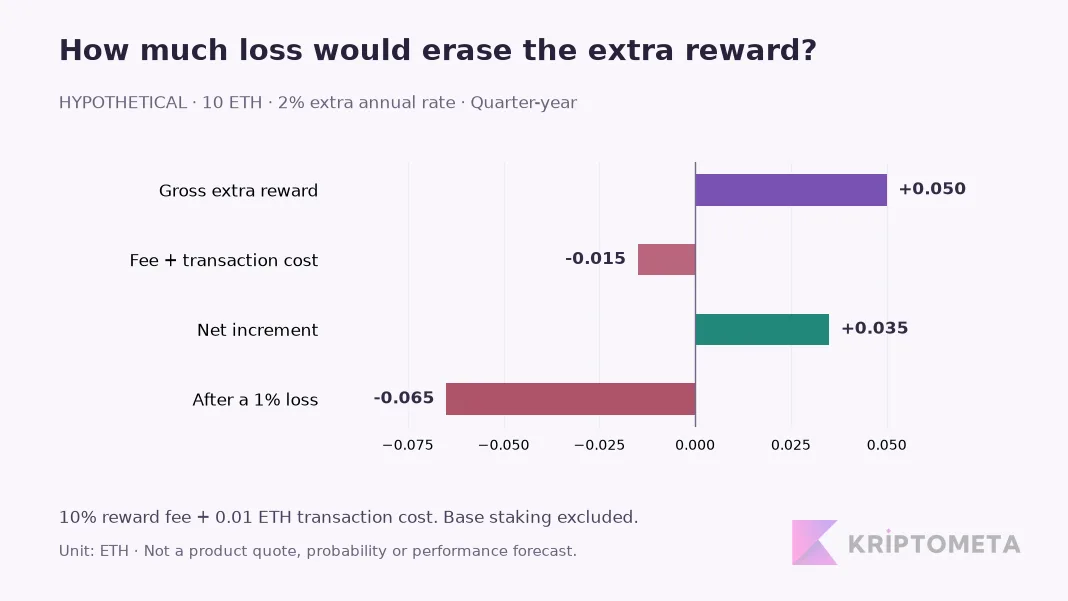
KriptoMeta's hypothetical calculation. It is not an estimate of loss probability, a live rate or measured product performance.
The 0.035 ETH net increment equals 0.35% of the 10 ETH position. A loss of that size during the period would erase the modeled gain. This is a sensitivity calculation, not expected-loss analysis: the latter would require evidence about both event probability and severity.
Check the reward token and whether advertised rates already deduct particular fees. The official rewards documentation does not make one operator split a permanent fee for every product. On the observation date, the interface announced the end of EIGEN emissions to the ETH quorum. That is not a statement that every AVS reward has ended. An expired incentive cannot be carried into a current return calculation.
Keep a decision record you can revisit
Bring the six checks into one note: asset and contract, allocation, penalty authority, end of exposure, executable exit and net incremental amount. Attach the source and observation date. When a condition changes, the affected part can be reassessed without starting from a marketing page.
A higher advertised rate cannot fill an evidence gap. Unresolved penalty or withdrawal terms are a concrete reason to postpone a transaction. The purpose of a restaking assessment is to understand the obligation behind the reward, not simply to find the largest percentage.