













CoinGlass puts derivatives data from multiple venues into one research workspace. We examine comparability, access and product boundaries rather than treating a dense dashboard as proof of predictive power.
A higher funding number on one exchange is not automatically the better opportunity. Does the screen use the same settlement interval, collateral type and definition of a finalized rate? Our CoinGlass review focuses on whether the data can answer a specific question correctly, rather than how many charts fit on the dashboard.
On October 22, 2026, we inspected the public Bitcoin open-interest and funding pages in a browser and compared Prime, API pricing and heatmap documentation. We did not purchase a subscription, place trades or run a performance backtest. Interface fields were directly observed; the visual below is an explanatory diagram, not an application screenshot.
What CoinGlass brings together
CoinGlass aggregates derivatives indicators across trading venues. It does not replace an exchange, a personal account statement or a custody service. Funding, open interest, realized liquidations and estimated heatmaps may contribute to the same investigation, but they measure different things.
| Area | Checked | Not established |
|---|---|---|
| Public tables | OI units, venue rows, change windows and funding options | Continuous freshness of every row or complete exchange coverage |
| Prime | Published pricing and access descriptions | The paid experience across every model |
| API | Separate plans, usage categories and request limits | Latency, historical-data quality or production reliability |
| Heatmaps | Estimated nature of the model and access boundaries | Predictive accuracy or exact liquidation levels of real accounts |
Which open-interest fields matter?
The Bitcoin open-interest table breaks down venues by BTC amount, dollar value, share and changes over several hourly windows. Open interest is an outstanding-contract stock; it is not an interest payment on deposited money. The Turkish interface we inspected uses the label “Açık Faiz,” so that wording should not be mistaken for a yield measure.
Showing BTC exposure beside its dollar valuation is useful. Rising Bitcoin price can lift dollar OI even if the outstanding quantity is unchanged. OI divided by 24-hour volume compares a stock with a flow; the ratio is neither account leverage nor a complete measure of market liquidity.
The aggregate table includes venues such as CME, where dated futures form part of the picture. A single exchange's USDT perpetual contract should not be equated with all Bitcoin derivatives. Coin-margined products on the same venue can introduce another coverage difference.
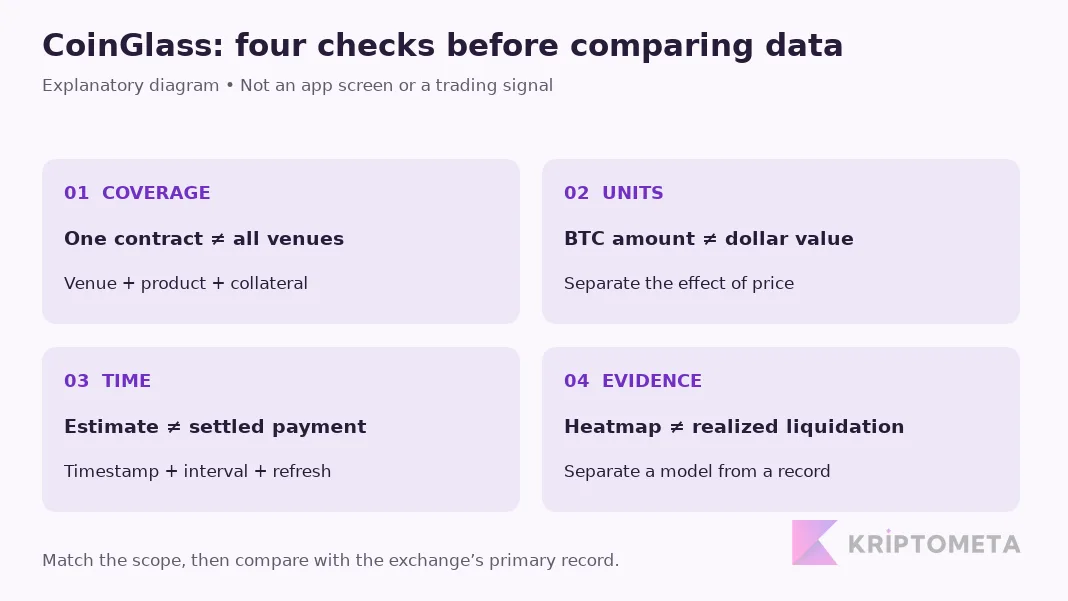
KriptoMeta explanatory diagram based on public interface fields and documentation. It is not an actual application screen or live market table.
Funding: check the interval before comparing percentages
The funding page separates USDT/USD-margined and token-margined products and offers current rates, historical windows and a prediction option. OI-weighted and volume-weighted averages need not agree. Changing the weights changes the meaning of the market average.
The page explanation presents rates on an eight-hour comparison basis and says that hourly dYdX rates are multiplied by eight. That display convention does not mean every underlying exchange settles funding every eight hours. Calculating a position's actual carrying cost still requires the contract's own schedule and finalized settlements.
Consider hypothetical displays of 0.01% and 0.008%. If the first covers eight hours and the second one hour, the raw percentages cannot be compared directly. Under simple linear normalization, eight payments of 0.008% total 0.064%; future hourly rates are not guaranteed to remain constant. The notional example in our funding rate glossary entry shows how to connect a percentage to a payment.
A heatmap is not a ledger of realized liquidations
Liquidation means a position has been forcibly closed under margin rules. A realized-liquidation table reports past events. A heatmap estimates potential concentrations. The CoinGlass model documentation describes calculations based on market data and leverage levels, rather than a complete margin statement for every trader.
Reading a bright zone as a destination price must reach attributes predictive certainty the evidence does not establish. The picture can change with the model, selected history or venue coverage. A highlighted level can help frame a research question; it is a weak standalone reason for an order.
Public access, Prime and API are different products
The Prime page listed $28 for a monthly subscription, $78 quarterly and $268 annually on the review date. The annual total should not be mistaken for monthly billing. Paid access expands available models, historical ranges and refresh features; public access varies by screen and model. Recheck the selected plan and checkout amount before purchasing.
Mobile coverage needs clarification. A feature card referred to website and app access, while the same page's FAQ described Prime heatmaps as currently available on the web and app support as planned. We did not verify the paid feature inside the app. A reader buying specifically for mobile use should obtain confirmation of the exact entitlement first.
API plans are listed separately. Buying Prime for web use does not automatically grant programmatic access. API tiers distinguish personal and commercial use, requests per minute, endpoints and historical coverage. A publisher building a website needs to check the permitted usage and required endpoint, not just the cheapest displayed price.
How we cross-checked the comparison method
Instead of comparing a CoinGlass aggregate with an arbitrary Binance number, our Bitcoin derivatives analysis isolates one BTCUSDT contract at fixed dates. BTC quantity, USDT valuation and settled funding remain separate. The purpose is not to grade a provider from one unmatched total, but to show how coverage can explain a difference.
- Write down the venue, pair and contract type.
- Record the displayed unit and update timestamp.
- Distinguish a funding estimate from a finalized settlement.
- Compare with a primary record under matching conditions; investigate scope and time before assuming an error.
Missing data is not zero volume or zero exposure. If an aggregate's excluded venues are unclear, a precise growth comparison against another aggregate may be impossible. Documentation and source-level checks matter more than the apparent precision of a percentage.
Strengths, limitations and suitable users
- Strength: It brings cross-venue derivatives research together and makes quantity, dollar value and alternative funding weights accessible.
- Limitation: Totals depend on product and exchange coverage. Estimated maps cannot be treated as equally certain as verified historical records.
- Access trade-off: Prime and API serve different needs; one subscription should not be assumed to cover every workflow.
- Good fit: A researcher who compares derivatives indicators regularly and is willing to return to exchange documentation.
- Poor fit: Someone expecting one color, percentage or long/short ratio to produce reliable automatic trades.
For onchain address and transaction queries, the Dune review addresses a different workflow. The DefiLlama review covers protocol TVL and DeFi research. CoinGlass's derivatives focus is an advantage when that is the question; it is not a reason to make it the starting point for every crypto investigation.


