





A successful transaction on the sending network does not mean the receiving balance is ready. Bridging requires checking the token version, delivery path and gas needed afterward.
Using a crypto bridge involves more than changing the network shown in a wallet. The asset is processed on the sending chain, while delivery creates a separate record on the receiving chain. Establish which token will arrive, on which network and in which account before comparing fees.
This guide uses Ethereum and EVM networks to explain route selection, cost accounting and delivery checks. We did not deposit funds to test a bridge; the evidence consists of official documentation and explicitly hypothetical examples. For a transfer that stays on one chain, use our cryptocurrency transfer guide instead of adding an unnecessary bridge.
1. Match networks and token identities
A blockchain bridge connects networks; it does not merge balances that happen to share an address. Record the source chain, source token contract, destination chain and destination token contract. For native assets such as ETH, follow the protocol’s native-asset designation rather than inventing a token contract address.
A symbol or logo is not verification. USDC, USDC.e and other representations may not have identical support in the receiving application. Verify the contract against the issuer’s or network’s official documentation, then separately check whether the exchange or application you intend to use accepts that version.
The recipient is a different field from either token contract. An ordinary EVM account can use the same address on several chains, but a smart contract wallet cannot be assumed accessible at that address on every network. Choose a recipient you can control on the destination. Bridge directly to an exchange deposit address only when the platform explicitly supports the delivery method; ordinary deposit support may not cover it.
2. Identify what the route actually does
Similar bridge buttons can invoke different mechanisms. Ethereum’s bridge documentation covers messages as well as assets. From the user’s perspective, the key questions are what arrives and what conditions govern getting back to the original asset.
| Mechanism | What happens? | What to verify |
|---|---|---|
| Lock and mint | Source assets are held; representative tokens are issued elsewhere. | The representation’s contract and redemption path. |
| Burn and mint | Source tokens are burned; tokens are issued after verification on the destination. | Supported assets, networks and message delivery. |
| Destination liquidity payout | Assets already available on the destination are paid to the user. | Net amount, liquidity, provider conditions and refund path. |
The label wrapped token does not identify a universal custodian or security model. Nor does every bridge create one: Circle CCTP burns source USDC and mints native USDC on the destination. Do not assume that outcome if your selected route uses a different mechanism.
A canonical bridge and a faster third-party route may have different timing and trust assumptions. Our rollup verification and exit-risk guide explains how to examine the network’s own withdrawal conditions. Fastest or cheapest sorting is not a security assessment.
3. Read the net amount and gas requirements on both sides
Separate the amount sent, expected receipt, any minimum received, service fees and network fees. A route that includes a token swap may also have a slippage limit. Expected output and minimum output need not match, and an expired quote may be recalculated.
| Item | Example | Accounting treatment |
|---|---|---|
| Source amount | 1,000 USDC | The token amount being transferred. |
| Route fee deducted from that amount | 2 USDC | 998 USDC net if the deduction is not already counted elsewhere. |
| Total source gas | 0.0006 ETH | Paid from a separate ETH balance, not subtracted as USDC. |
| A later destination transaction | Quoted when needed | Requires destination gas or explicit support for sponsorship. |
If the quote already says you receive 998 USDC, do not deduct the 2 USDC twice. To express gas in USDC, record the ETH conversion price and timestamp. The numbers above are illustrative. Our Ethereum gas calculator can help estimate the Ethereum leg; it does not automatically include another network’s fees or the bridge service charge.
Receiving USDC does not necessarily fund the native gas needed to move it afterward. Some routes offer gas top-ups or sponsored execution; do not assume either unless it is explicitly supported. Leave enough source gas for approval and bridging rather than sending the entire native-asset balance.
4. Read the allowance and the transfer separately
An ERC-20 route may require a spending approval before the transfer. Check the spender, token and amount. An unlimited approval is not equivalent to authorizing only the current transfer size. The token approval and revocation guide explains how to inspect that permission. Native ETH transfers do not require an ERC-20 approval.
At confirmation, compare the chains, recipient, destination token, minimum receipt and any additional completion step. Where minimums and fees allow, a small test can establish that the normal delivery flow works. It cannot prove the absence of contract vulnerabilities or malicious changes affecting later transfers.
5. Match source confirmation to destination delivery
Keep the source transaction hash, bridge transfer or message identifier, and destination hash once available. Success on one chain establishes only the execution of that transaction. Our block explorer tracking guide helps read the source status; verify the destination token transfer on the receiving chain’s explorer.

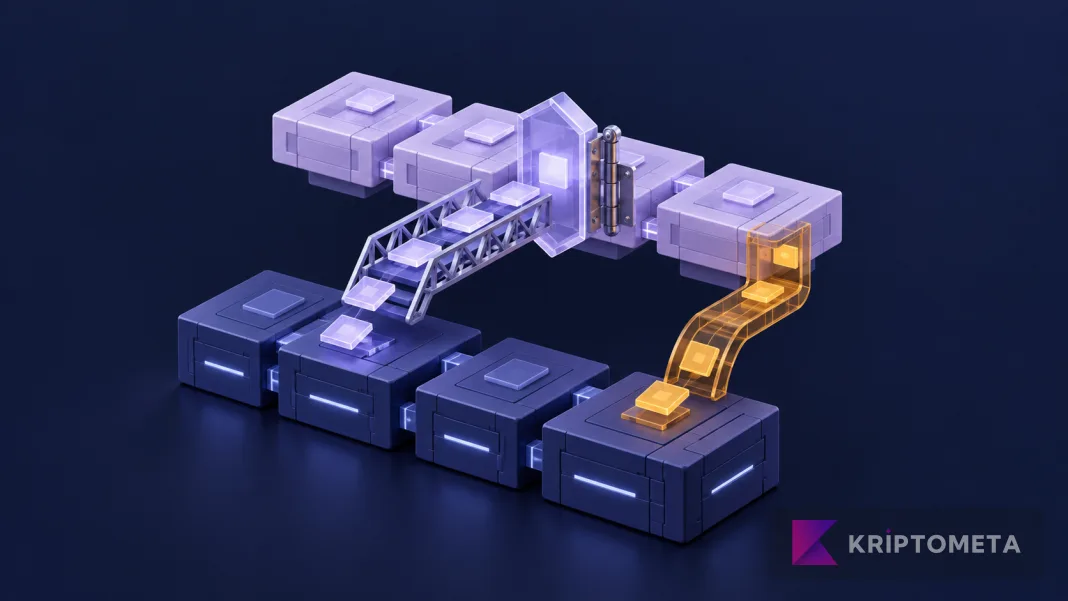
Source confirmation, message processing and a usable destination balance are separate checks. The diagram explains the sequence; it is not a wallet or bridge screenshot.
The OP Standard Bridge documentation defines source token, destination token and recipient separately. Destination execution follows the source lock. Its seven-day challenge period for standard OP Mainnet withdrawals to Ethereum is route-specific, not a universal bridge waiting period. Routes requiring proof or finalization also need those steps completed and the relevant networks to keep processing transactions.
If the destination explorer shows the correct recipient, token and amount, check that the wallet is displaying the right network. Adding a token to a wallet’s visible list does not create a balance; it displays an existing one. Follow any required claim or completion step through the verified bridge interface, not a link sent by an unsolicited support account.
Where to look when a transfer stalls
- Source still pending: Inspect the sending chain before searching for destination delivery.
- Source succeeded, no destination record: Check message status, the route’s timing, the service status page and any required next step.
- Destination succeeded, wallet looks empty: Match recipient, chain and contract to separate a display problem from a delivery error.
- Wrong asset or recipient: Stop sending funds. Contact official support with the transaction and message records; recovery is not guaranteed.
Keep the quote, chains, token addresses, recipient, amount and identifiers together. That record makes a support request much more precise. KriptoMeta’s final check is not merely a higher balance: the correct asset must be usable in the intended destination application. A request for recovery words is not a legitimate step in diagnosing the transfer.