






Learning how to vote in a DAO involves more than connecting a wallet. You need to know what you are authorizing, when voting power is measured and how an approved decision will be executed.
A wrong wallet address, a missed reference block and an unexpected signature request can look like one confusing interface problem, but each calls for a different check. A short record from proposal to execution helps you identify the stage that needs attention.
The walkthrough focuses on classic offchain Snapshot. On 12 October 2026 we opened SafeDAO’s public proposal and delegate screens without connecting a wallet, signing or casting a vote. Snapshot X and other onchain systems can have different fee and execution rules. The general DAO definition is covered separately.
1. Match the official proposal to the discussion
Start from the community’s known official website and follow its governance forum and voting links. A search title, shortened message link or familiar logo is not enough. Match the space, proposal ID, network, author and version with the forum record.
First answer a concrete question: What changes if this proposal passes? For funding, note the amount, asset, recipient and delivery conditions. For a parameter change, note the old value, proposed value and affected market. A familiar title can conceal a revised proposal that differs from the first forum draft.
The SafeDAO SEP 55 record shows a request involving 5 million SAFE over six months and a closed voting window. It is an example of separating a request from its voting status, not an endorsement. Closed and the dates tell us voting has ended; they do not establish that the funding was transferred.
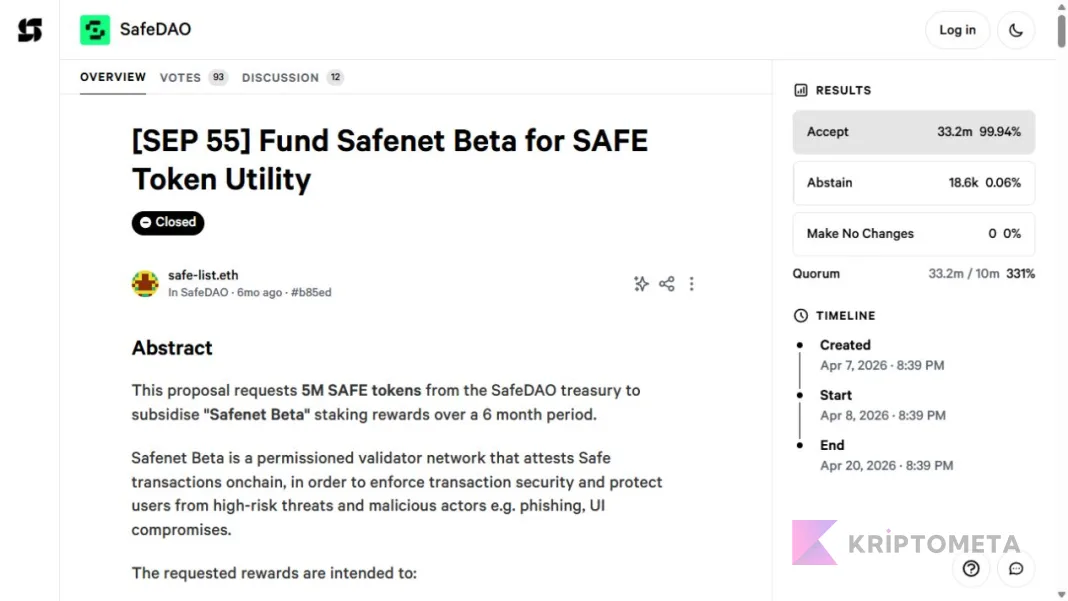
Actual Snapshot screen opened on 12 October 2026. The closed proposal is used for inspection only. Timeline shows the voting schedule; displayed time can depend on user settings.
2. Establish where your voting power comes from
Snapshot’s participation documentation ties eligibility to the space’s strategies and validation rules. Today’s wallet balance is not enough. Check the correct address, relevant token or NFT, any required delegation and the proposal’s reference block.
Suppose a hypothetical proposal measures eligible balances at block 1,000. Alex holds 120 qualifying tokens at that block and acquires another 80 at block 1,010. The later purchase does not turn the earlier measurement into 200. If the system separately requires delegation, a visible balance alone still does not prove voting power. The rights attached to a governance token vary by project.
If voting power is zero, investigate the address and measurement point before buying more tokens. A strategy or RPC failure is different from genuine ineligibility. Save the error message and proposal URL so those cases can be distinguished.
3. Separate voting yourself from choosing a delegate
If you cannot follow every proposal, a community supporting vote delegation may let you choose a representative. Do not choose solely by the largest voting-power number. Previous voting explanations, consistent participation and disclosed conflicts are more useful checks.
SafeDAO’s Delegates section shows a statement, delegator count and voting power in separate columns. A large number does not establish that the representative shares your views. Where a statement is absent, look for past votes and forum contributions rather than guessing the person’s intentions.

Actual public delegate list, captured 12 October 2026. The columns support candidate research; no address shown is a recommended representative.
The mechanism described in Snapshot’s delegation documentation depends on the registry and strategy used by the space. Check which community the authority covers, whether it extends more broadly, how to revoke it and when a change becomes effective. Transferring tokens, staking and delegating voting rights are different actions.
4. Select options according to the voting type
Single-choice voting selects one option. Weighted voting can split voting power. Approval voting can support several options without dividing that power into equal pieces. Read the relevant Snapshot voting-type rules before selecting.
With a hypothetical 100 voting power, an equal split between A and B in a weighted model allocates 50 to each. Under an approval model, approving both can give each option 100 under the defined rule. Selecting two boxes does not necessarily mean splitting a vote in half.
Abstaining can also differ from not participating. Check which choices count toward quorum and what passing requires. A visible majority does not by itself establish that the participation threshold was met.
The MIM wind-down vote that closed on 30 September 2026 provides a dated example of strong support failing to meet a participation threshold. It shows why checking the quorum line matters even when the support percentage looks decisive.
5. Read the wallet request, then verify the record
A normal classic Snapshot vote uses an offchain message signature rather than a gas-paying onchain transaction. Snapshot’s FAQ describes that distinction. Connecting to a site alone does not cast a vote: the selection and signature must be followed by a record check.
- Domain and account: are these the expected website and wallet address?
- Proposal and choice: do the identity, selected option and authority match what you intended?
- Request type: are you being asked for a transfer, unlimited spending approval or another unexplained permission instead of a vote?
Stop and recheck the source if the request differs. A “free” signature is not a universal safety guarantee. Our token approval guide explains the distinction between permissions. Never enter recovery words or a private key in a voting form.
After submission, check your address, choice and recorded power in the vote list. If an error appears, check whether the record exists before repeatedly signing. Classic Snapshot allows a new vote during the active period to replace the previous choice; do not assume another platform follows the same rule. Confirm that the latest record reflects any correction.
6. Track the result separately from execution
At the close, read the passing rule, participation threshold and final count together. Then establish who can execute the decision. Integrations such as SafeSnap have separate verification and waiting conditions; not every community uses them.
For a spending proposal, look for the execution record, transaction identifier and destination. For a parameter change, look for the executed call and new value. An approval announcement is not evidence of a completed onchain action. Our DAO governance analysis examines the separate issue of concentrated voting and execution power.
| Stage | Record to keep | What it does not yet prove |
|---|---|---|
| Proposal | Official URL, ID, version and deadline | That your address can vote |
| Eligibility | Address, reference block, strategy and power | That a vote was submitted |
| Vote | Recorded choice and latest vote record | That the proposal passed |
| Result | Quorum and passing conditions | That execution occurred |
| Execution | Execution record and relevant transaction or value | That the decision was economically successful |
A short record reduces the work you must repeat for the next proposal. Our Snapshot review separately assesses the interface’s strengths and limitations. Meaningful participation means knowing what authority you granted and being able to follow what happened afterward.