











Compare what remains in the wallet, not the headline quote. CoW Swap’s public limit interface, signature model and execution costs define the decision.
Our CoW Swap review starts with a practical question: what result does the user authorize when signing an order? The net amount received, the minimum accepted output and the conditions for a fill tell more than a label suggesting that order placement is free.
On October 23, 2026, we inspected the public Ethereum WETH/USDC swap and limit interfaces on CoW Swap without connecting a wallet. The displayed version was v3.32.0. A verification screen prevented access to the executable quote flow; we did not solve the CAPTCHA, sign an order or trade real funds. The assessment combines observed public screens, official documentation and explicitly hypothetical calculations.
What problem does CoW Swap address?
The CoW Swap interface passes outcome-based trade orders to CoW Protocol. Under the intent and solver model, competing solvers search for acceptable execution paths. Opposing demand can be matched; external liquidity can cover orders without a suitable match. The protocol documentation describes the sources beyond a single pool.
The attraction is specifying boundaries such as minimum output and validity instead of choosing every routing step. The trade-off is that signing does not mean settlement has finished. For a user who needs immediate execution, an unfilled or expired order is a material limitation rather than a cosmetic inconvenience.
What did the public interface show?
The limit form exposed Receive at least, a price condition, Order expires in and Fee: FREE. It also warned that an order might not fill precisely when the market reaches its limit. That is where free placement must be separated from execution without economic cost.
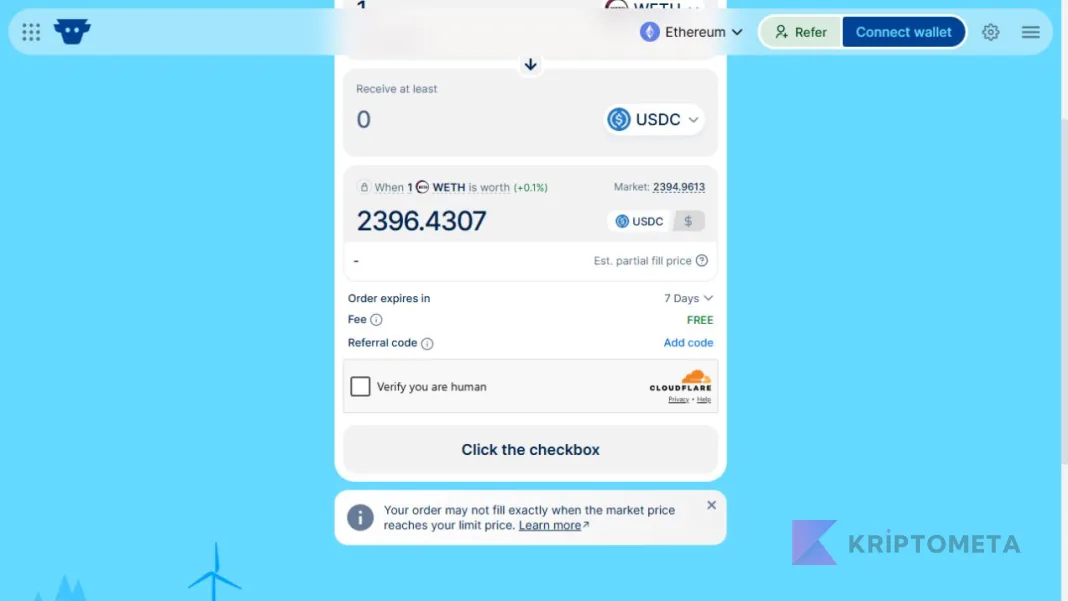
Actual CoW Swap limit-form detail, October 23, 2026. The price field is an order condition, not evidence of a completed trade or verified executable net quote. The note below the form explains the fill limitation.
A sensible reading order is network and token contracts first, then sell amount, minimum receipt, recipient and expiry. The wallet request must correspond to those conditions. A populated default is not evidence that the setting suits the user's purpose.
The documented swap workflow separates token approval from signing an order. An unlimited allowance may reduce repeated approval steps while leaving a broader permission active. Our token approval review and revocation guide explains that separate check. A good execution route cannot repair an authorization that directs the output to the wrong recipient.
Does gasless mean free?
No. Gasless can mean that the user does not submit a separate network transaction in a particular flow. Execution still has a cost. The technical execution model separates protocol charges from solver execution costs. Rather than applying one supposedly permanent percentage to every network and order, compare the net quoted output after applicable charges.
Selling native ETH is not automatically identical to selling an ERC-20 token. The native-token flow documentation explains that Eth-flow incurs upfront on-chain gas that is not refunded when an order fails. Understanding WETH versus ETH helps explain why a user can incur a cost without completing the intended swap.
A 1,000 USDC comparison
Imagine two contemporaneous quotes. Route A shows 0.4000 WETH after its included charges, with a separate wallet-paid network cost equivalent to 0.0010 WETH. Route B quotes 0.3994 WETH with the relevant execution costs already included. A leaves an economic net of 0.3990 WETH; B leaves 0.3994 WETH.
Despite its larger displayed receipt, A leaves 0.0004 WETH less net value in this example. Do not subtract a charge twice if it is already included. A first-time token approval, if needed, belongs on a separate cost line. These are invented values for demonstrating the comparison, not live CoW Swap or competitor quotes.
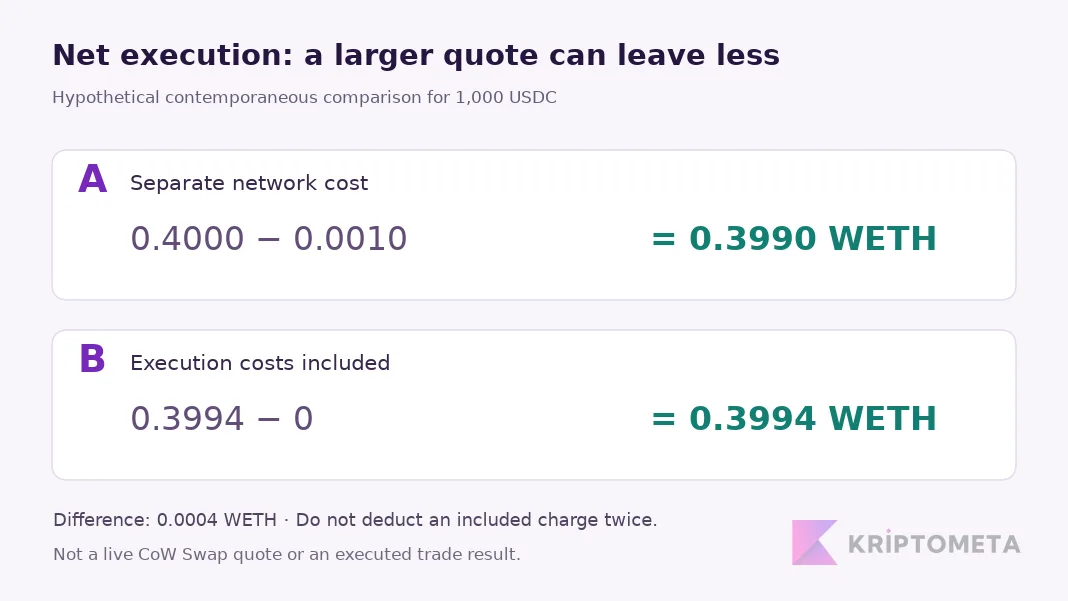
Hypothetical cost comparison. It excludes a deviation in USDC's reference value, conversion differences and price movement. A real comparison must match the network, token contracts, timestamp and input amount.
Why might an order remain open after touching its limit?
The limit-order documentation says execution needs a price that covers both the order constraints and network costs. A partially filled order can leave a small remainder that is uneconomical to execute. Price, expiry and the partial-fill choice must therefore be read together.
Cancellation is not a reversal of an already completed swap. An order can fill before an off-chain cancellation is processed; an on-chain cancellation also has a race until confirmation. Checking the old order's state in CoW Explorer before creating a replacement helps reveal overlapping commitments. The explorer links an order identifier to the batch transaction that settled it.
Where does MEV protection stop?
Batch pricing and solver competition aim to reduce some ordering-related extraction opportunities. Protection is not a certificate covering malicious tokens, incorrect contracts, broad tolerances or inadequate liquidity. Our MEV transaction-ordering analysis separates ordering effects from pool depth with a reproducible calculation.
The solver rulebook distinguishes conditions enforced by contracts from rules enforced off-chain or through governance. The reader should examine the signed boundary and net output alongside the protection label. Even audited contracts do not justify a claim of zero risk.
When does it make sense beside Uniswap or Curve?
| Need | Option to inspect | Decision criteria |
|---|---|---|
| Conditional orders and route competition | CoW Swap | Net quote, minimum, validity and fill state |
| Inspect pool and swap workflows together | Uniswap | The selected flow's route, permissions and costs |
| Evaluate pools of similarly valued assets | Curve | Pool composition, curve and exit depth |
Our Uniswap review and Curve review examine those other workflows. Do not assume that a product name implies a single execution method; interfaces can offer several order types. CoW solvers may also source liquidity from external pools, so the alternatives are not always mutually exclusive. Comparing net outcomes for the same input is more informative than comparing slogans.
Strengths, limitations and editorial verdict
- Strength: Define minimum receipt and validity at order level, then distinguish submission from settlement.
- Strength: Potential matching between opposing orders and competition across liquidity routes.
- Limitation: A signature does not guarantee a fill; costs, available balance and market conditions can leave an order waiting.
- Limitation: Recipient and allowance checks remain necessary; gasless does not mean every step is free.
CoW Swap is worth comparing for users prepared to read order conditions and monitor the outcome. It requires more understanding from someone expecting immediate execution or treating a signed order as an ordinary transfer. Without a completed-trade test, we do not assign a speed score, a success rate or a claim of consistently superior pricing.