

















Your first DeFi decision is what you want your assets to do. Swapping, supplying a lending pool and providing liquidity create different obligations; choosing a route means budgeting for the way out as well as the way in.
Choose the DeFi activity and its exit before connecting a wallet. “Swap”, “Supply” and “Liquidity” are different commitments: each changes where your assets sit and what you need to monitor.
Choose the job: swap, supply or provide liquidity
A swap changes one token into another. Supplying places assets in a lending pool for borrowers to use. Providing liquidity supports trades through a pool position that you must understand and manage. Combining all three in the first trial makes it harder to identify the source of a cost or an unexpected result.
| Activity | What changes? | What does the exit require? |
|---|---|---|
| Swap | You receive an output token in exchange for the input. | Liquidity and an acceptable net quote for the return trade. |
| Supply a lending pool | Assets move into protocol contracts; the supply rate can change. | Available liquidity and, if used as collateral, compliance with the active loan’s conditions. |
| Provide liquidity | You hold a pool share or position; its asset mix can change. | Removing the position, collecting fees and converting into the asset you want. |
Supplying is separate from borrowing. Opening a loan adds collateral prices, accruing debt and liquidation risk to the monitoring task. The DeFi collateral and liquidation guide covers that calculation and response process. Borrowing is not a prerequisite for a first DeFi transaction.
Four facts to establish before connecting
- The genuine product address: Verify the domain through the project’s official documentation. Stop if a website asks for wallet recovery words.
- The network and asset identity: A ticker alone is insufficient. Check the supported network and the token’s contract address on it; the same symbol can describe different assets.
- A compatible wallet and gas balance: The wallet must support the chosen network. Ordinary Ethereum transactions require ETH for gas; a stablecoin balance is not automatically a gas balance.
- The scope of permission: Connecting, approving spending and confirming a transaction do different jobs. Do not sign a request if you cannot explain the spender and the amount it authorizes.
A crypto wallet manages access through keys. The application’s smart contract is another part of the decision. Recognizing a wallet brand does not verify the application you are connecting to.
Budget for the round trip, not just entry
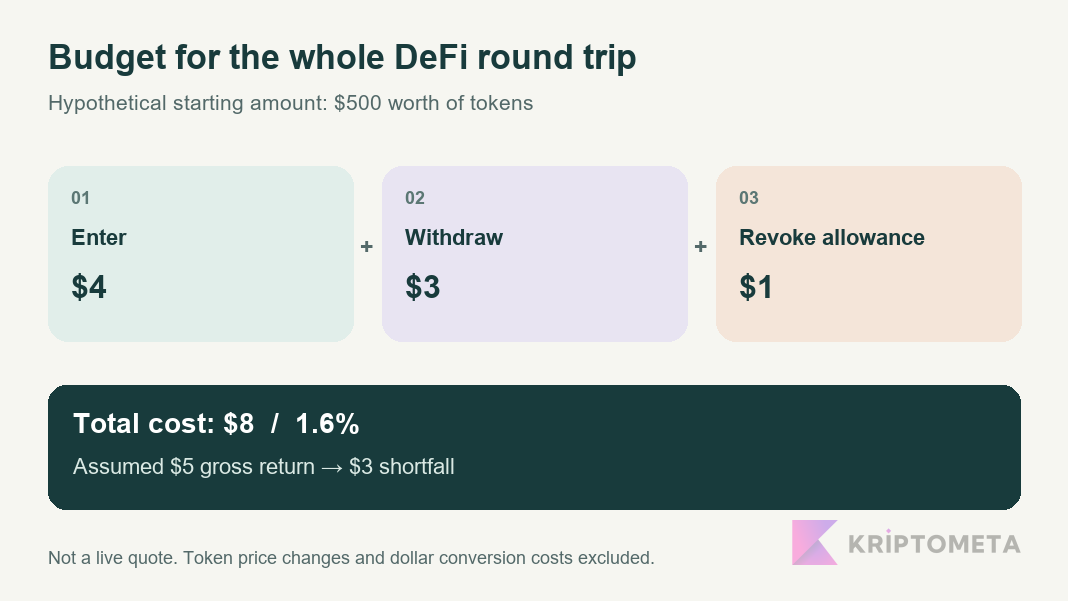
An inexpensive entry can lead to several exit transactions. Include any approval, the main action, closing the position and revoking an unused allowance. These costs do not necessarily occur together: network conditions may be different when you leave.
Hypothetical example: You plan to supply $500 worth of tokens briefly. Set aside $4 for entry, $3 for withdrawal and $1 for revoking an allowance. The $8 round trip equals 1.6% of the initial amount. If the expected gross return over that period is $5, the result is a $3 shortfall even with unchanged token prices. These are illustrative costs, not current quotes or promised returns; converting the tokens back into dollars is excluded.
The Ethereum gas fee calculator can help you work through network execution costs. That calculation does not automatically include a pool fee, price impact or bridge charge. Read the current amount in the wallet’s confirmation screen again; an estimated budget is not a binding maximum.
Give the first trial a narrow success criterion
A useful first target is “I used the correct asset on the correct network, understood the action and verified its result.” Making a return is a separate outcome. Do not learn with an amount you cannot afford to lose. A small deposit does not necessarily contain the consequences of signing a broad token allowance.
Before submission, record the input, expected output or position, minimum acceptable output and estimated fee. Afterwards, compare the result with the transaction record on the correct network. A supply operation should create the expected lending position; a swap should deliver the intended token; providing liquidity should create the intended position. If you cannot reconcile the result, stop before starting another trial.
Check the exit before entering
Withdrawing supplied assets may depend on available pool liquidity. In Aave, using those assets as collateral can create further withdrawal constraints. Our review of Aave’s supply and risk screens explains which conditions belong beside the displayed balance. Disconnecting a wallet from a website does not close a position.
Do not assume that removing liquidity returns the original token mix. A concentrated liquidity position can become entirely one asset when the market leaves its selected range and may stop earning trading fees. Before comparing reward rates, establish which asset you could be left holding. If you choose the pool route, our liquidity provision guide works through range selection, fee allocation and withdrawal checks.
Leaving a swap position means making another trade in the opposite direction; the original exchange rate and fee need not survive. Moving to another network can add bridge costs and a need for gas at the destination. Review unused permissions through the token approval revocation guide. Disconnecting and revoking are separate actions.
When should the transaction wait?
If the exit asset is unclear, total fees exceed your learning budget or the signature’s authority remains unexplained, the transaction is not ready. Moving to a network with lower apparent fees does not settle those questions: the asset version and return route may change.
Write a one-sentence decision note: “I will use this asset on this network for this purpose, verify the result in this record and leave under these conditions.” A blank in that sentence identifies a concrete information gap. Closing the interface and investigating that gap is a valid outcome.
For a real interface example, the PancakeSwap review walks through networks and quote details, separating information available before connecting from final wallet confirmation.
