











MetaMask gives users separate controls for connected accounts and networks. Its convenience still depends on understanding spending permissions, recovery responsibilities and the full cost of a swap.
Our MetaMask review starts with practical questions: Which website can see an account, which networks can it use, and how much crypto remains after a swap? A shared view of several accounts can make everyday checks easier. Reading what a permission actually allows remains the wallet owner’s job. Those decisions, rather than the number of buttons on the home screen, guide our assessment.
What we examined
On September 26, 2026, we opened the official web app without connecting a wallet and checked its public interface against MetaMask’s help documentation. The permission images below come from the official help center. We did not install a wallet, sign a transaction or conduct an independent security audit. We therefore make no measured claims about speed, transaction success rates or resistance to attacks.
Account access and network access have separate controls
MetaMask’s app-permissions screen separates connected accounts from enabled networks. The first “Edit” control changes which accounts are shared; the second changes network access. Connections are also available through “All Permissions” in the menu.
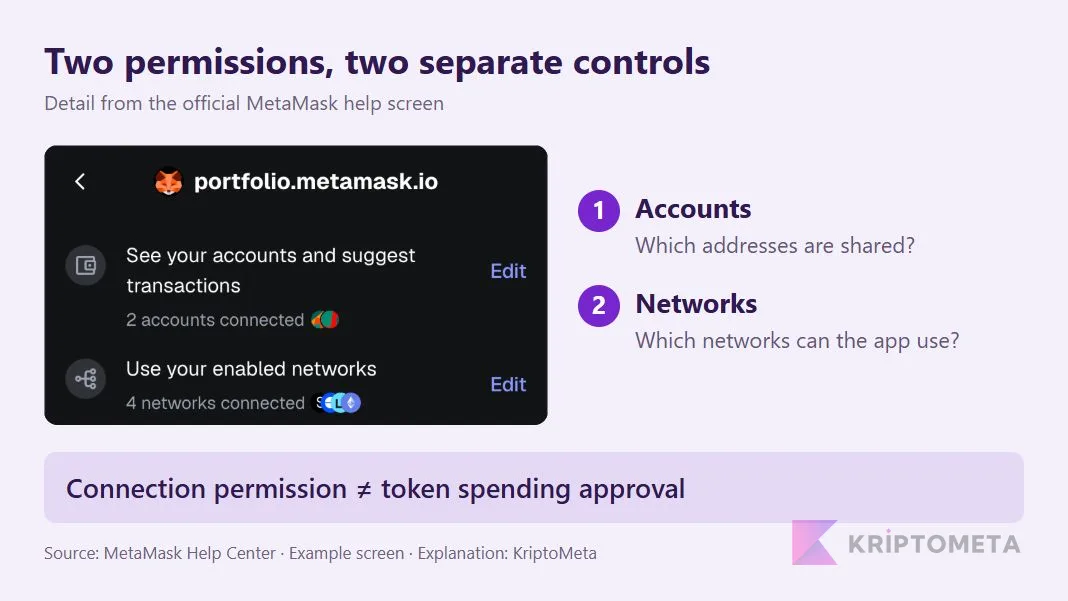
The two accounts and four networks shown belong to MetaMask’s example screen. They are not recommended settings for your wallet. If a task needs only one account, sharing the others with the same site may add no benefit. What matters to us is being able to inspect the scope before proceeding, rather than treating every checked option as useful convenience.
An ordinary app connection and a token spending approval are different permissions. Connecting lets the app see selected accounts and propose transactions. Authorizing a contract to spend tokens is a separate decision. Confusing the two means judging a request by the wrong level of access.
A concrete decision with two accounts
Suppose Alex keeps an everyday app account and a savings account in the same MetaMask view. If a site is needed only for the everyday account, sharing the savings address adds no necessary access. Separating account connections narrows address sharing; it does not turn accounts dependent on the same recovery material or device into independent security vaults.
Next identify the requested action: account connection, spending authority for a token, or a direct transfer. A narrow selection in the connection window does not automatically make the next signature safe. Separate controls are useful; treating every prompt as another step in one harmless approval flow is the practical weakness.
A network filter does not move crypto between chains
The current interface can display assets across enabled networks. Portfolio filtering and an app’s active network serve different purposes: a filter changes the view, while the connected app’s network determines where it operates. Separate apps can use different networks.
Selecting Ethereum in a filter does not bridge that balance to Base. Nor does seeing the same token symbol on two chains make their balances interchangeable. Check the asset, network and receiving address together before a transfer or swap. Bringing networks into one interface is useful; it does not make a wrong-network selection impossible.
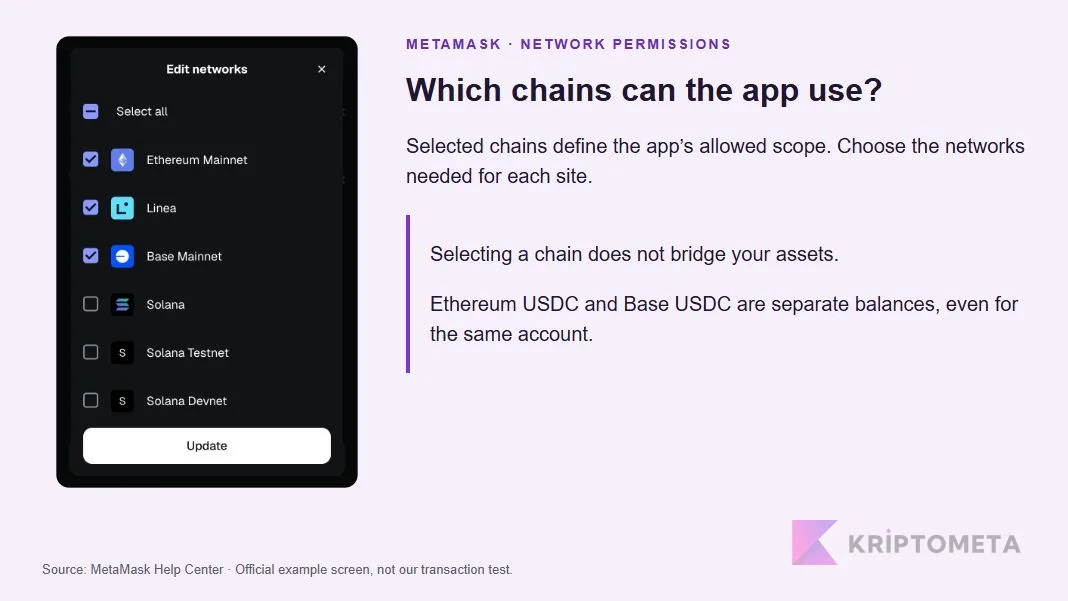
Official help-center example of network permissions. Selected chains define the app’s allowed scope; the screen does not show assets being bridged.
Preparing a Base action while holding assets on Ethereum
Suppose the portfolio displays Ethereum and Base while an app requests an action on Base. Seeing USDC on Ethereum does not establish a spendable Base balance. Check the selected account’s Base assets and the transaction’s gas-payment conditions. Without a supported sponsored or alternative gas flow, the network’s native fee asset may also be needed. Changing the display filter cannot resolve a mismatch between assets, chain and execution method.
What does disconnecting actually remove?
The disconnect documentation draws a clear boundary: removing an app connection does not revoke token approvals already recorded on-chain. Public address history does not disappear either. After finishing with an app, assess its outstanding authority using the distinction in our token-approval revocation guide, rather than relying only on “Disconnect.”
Some supported apps offer another model. Advanced permissions can authorize actions within amount and time limits without asking for fresh approval each time. “MetaMask always requires a separate signature for every action” is therefore an unsafe assumption. Read the limit, expiry and revocation conditions before granting that authority.
Compare the final amount, not just the fee percentage
At our review date, MetaMask’s FAQ listed a 0.875% service fee included in Swaps quotes. That is not a commission on every transfer made with the wallet. The Swaps fee explanation distinguishes the exchange rate, network cost and MetaMask fee.
Worked example: for a hypothetical $1,000 swap amount, 0.875% equals $8.75. Dollars are simply the unit of account here; we are not using a live quote. Do not deduct the service fee twice when it is already included. The route’s network cost and any required token-approval transaction also need consideration; use the final transaction screen for actual amounts.
Compare offers for the same input amount, on the same network and close together in time. A low stated commission can be outweighed by a worse exchange rate, network costs or a smaller net output. For small swaps, a fixed network expense can represent a substantial share of the trade.
The less obvious difference between two quotes
For the same input, suppose quote A offers 990 USDC plus a separate $4 network expense, while B offers 988 USDC plus $1. Treating USDC as $1 only for the calculation gives comparable results of $986 and $987. The larger token output can leave less economic value after costs. If the service fee is already reflected in output, do not subtract it again.
Do not equate minimum received with estimated output: slippage tolerance is an execution condition. If approval requires a separate on-chain transaction, include that expense too. The example demonstrates a comparison method; it is not a live price measurement between MetaMask and a competitor.
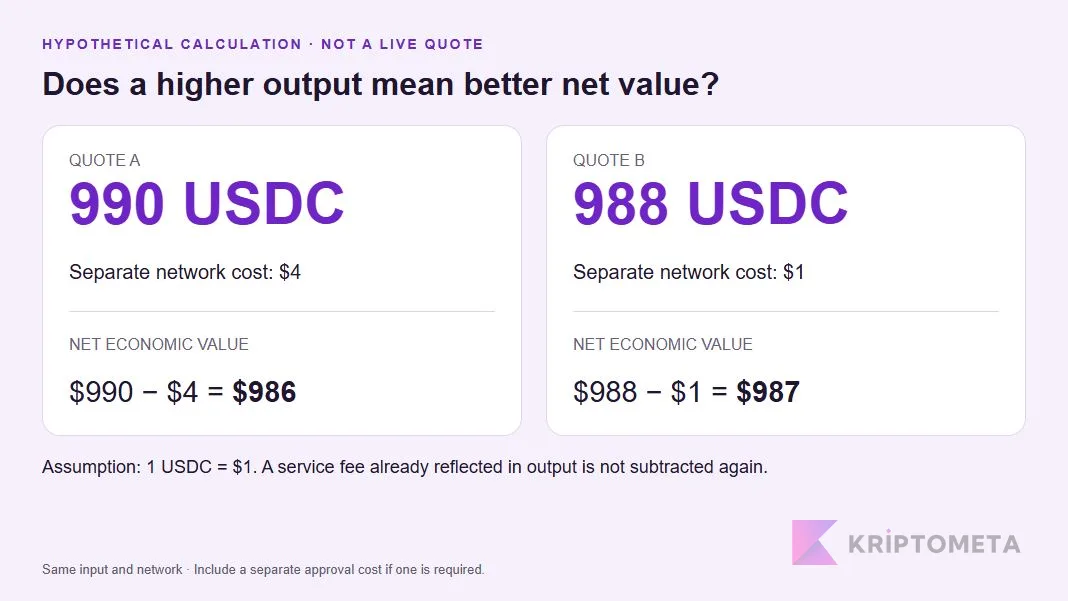
Hypothetical quote comparison, not a real product screen or market offer. The same assumptions and arithmetic are explained in the text.
MetaMask, Rabby or a hardware wallet: which need?
For EVM apps, Rabby is a comparable browser-wallet option. Assessing MetaMask only by its older Ethereum-only scope would understate its current product coverage. Compare the chains you need, whether the app recognizes the wallet and whether you can understand the permission request. We did not install Rabby and sign the same transaction, so we make no speed or security superiority claim.
Long-term storage calls for a different criterion. MetaMask’s hardware-wallet connection can separate the interface from the device holding signing keys. A hardware wallet need not replace MetaMask: the two can work together. Importing the device’s recovery words into a browser wallet is not the same as connecting the device. Nor does physical confirmation make malicious contract authority harmless.
If convenient swaps matter most, compare MetaMask Swaps with the Uniswap interface for the same network and input. Connecting MetaMask to Uniswap is not the same as using MetaMask Swaps. Separating the wallet choice from the trading-service choice makes their fee models easier to assess.
Where convenience ends and responsibility begins
| Area | Convenience | Remaining user decision |
|---|---|---|
| App connection | Separate account and network permissions | Whether the requested scope is needed |
| Multichain view | Assets visible in one interface | Which chain and address the transaction will use |
| Built-in swaps | Quote search and transaction flow in one place | How the net result compares with other options |
MetaMask is a plausible choice for someone who regularly uses crypto apps and is willing to inspect permissions. Someone seeking long-term storage should not automatically count more app connections as an advantage. Our comparison of five crypto wallets narrows the alternatives by network and intended use.
Our verdict: MetaMask’s control scope is a reason to consider it for regular app use when the user can read account and network permissions. For storage-only needs, or someone likely to dismiss every prompt unread, feature density is not an advantage. Start by limiting the accounts and networks a task needs, then assess each signature separately. Accounts using a recovery phrase need a separate seed-phrase storage plan. A successful connection or a familiar fox logo does not establish that the connected website is trustworthy.