A practical review of OKX trading tools, regional fee differences and reserve verification, with real interface captures and comparisons against Binance and Coinbase.
Choosing OKX starts with the account and order you intend to use. Spot trading, margin borrowing and perpetual futures have different cost structures. Regional entities also offer different services, so an English-language interface should not be treated as a universal product menu.
This assessment uses official documentation, fee schedules and public interface captures checked on November 29, 2026.
Our verdict: Strong order control, with a learning curve
At KriptoMeta, we consider OKX a strong candidate for users who understand order books and calculate costs by product. Its exchange tools suit active traders who want limit orders and, where eligible, derivatives in the same product family. Someone making a small monthly purchase should begin with the spot workflow and leave unrelated features alone.
| Factor | Assessment |
|---|---|
| Strengths | Published maker/taker schedules, order-book controls, reserve-verification materials and passkey support. |
| Drawbacks | Regional fee and product differences, a dense interface and derivative costs beyond the headline trading fee. |
| Best fit | Users who deliberately choose order types and check the tariff attached to their account. |
| Look elsewhere when | Your region lacks the required funding route or product, or you want only a simple purchase experience. |
Check the entity before comparing features
The centralized OKX exchange and OKX Wallet serve different custody needs. An exchange balance is maintained by the provider; a self-custody wallet involves control of wallet keys. Moving between products under the same brand does not remove that distinction.
US readers should check the current US availability page rather than rely on older blanket claims that OKX is unavailable nationwide. At the review date, the exclusion list included New York and several US territories. The US disclosure describes spot and buy/sell/convert services. Access to a global futures page is not evidence that the same product is available to a US account.
In the EEA, the regional fee document publishes two account setups. Regular spot rates without an X-Perps derivatives account are 0.20% maker and 0.35% taker; the schedule for accounts with X-Perps shows 0.08% and 0.10%. Compare the cost of the account you need instead of opening an unrelated derivatives account merely to chase a headline rate.
Trading fees: Apply the rate to the right amount
The global public fee schedule displayed Regular standard-spot rates of 0.08% maker and 0.10% taker, and futures rates of 0.02% and 0.05%, when checked. Your jurisdiction, tier and trading-pair group determine the applicable tariff.
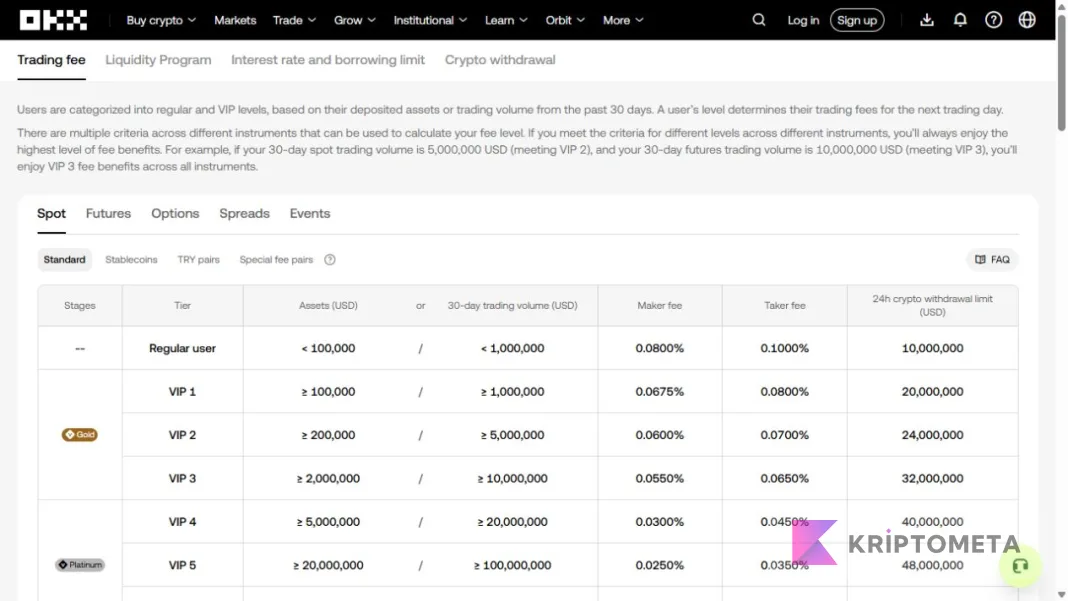
Global standard-spot schedule captured November 29, 2026. Use the account-specific schedule for an executable fee check.
| Product and role | Rate | One-way fee equivalent |
|---|---|---|
| Global standard spot maker | 0.08% | 0.80 USDT |
| Global standard spot taker | 0.10% | 1 USDT |
| Global futures maker | 0.02% | 0.20 USDT |
| Global futures taker | 0.05% | 0.50 USDT |
A 1,000 USDT taker purchase followed by a 1,000 USDT taker sale therefore costs 2 USDT equivalent in trading fees under that spot tariff. The calculation excludes price changes, spread and withdrawal costs. Where a fee is deducted from the received asset, the actual balance deduction is in that asset; the table expresses a common comparison unit.
A limit order is not automatically a maker order. A limit that immediately crosses an available quote takes liquidity. A portion resting on the book can later earn maker treatment. Compare each fill's fee, quantity and execution price, using the method in our exchange trading-fee comparison.
Read the trading screen before entering an amount
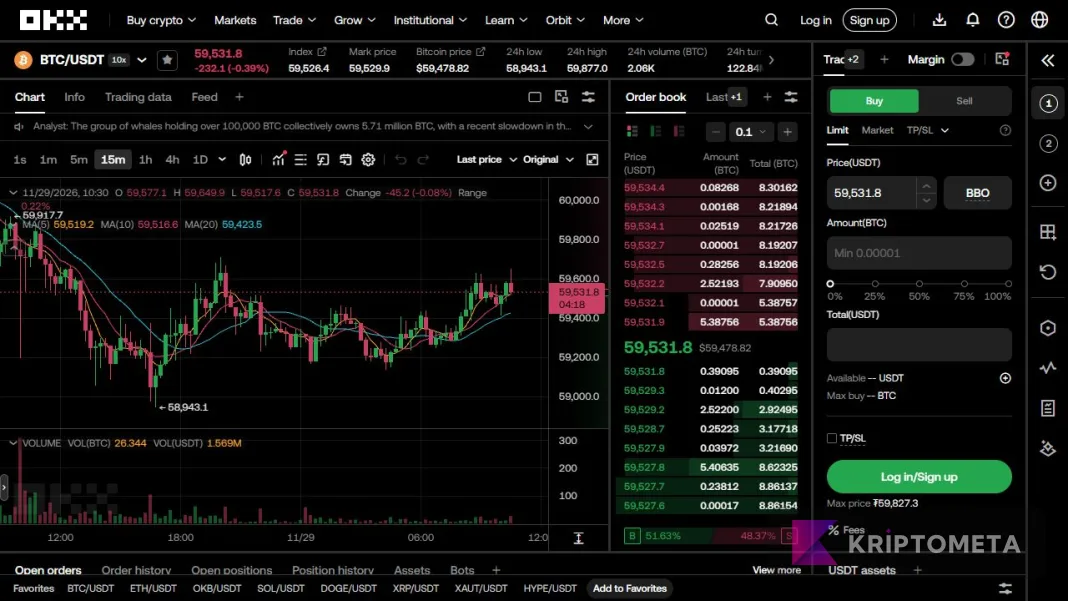
November 29, 2026: chart on the left, order book in the middle and Limit/Market controls on the right. The margin toggle is off.
For BTC/USDT, the amount field is denominated in BTC and the total in USDT. Confusing them changes the intended budget. A leverage label beside the pair does not describe an existing position: read the selected trading mode and margin setting.
- Choose the intended pair and spot mode.
- Select Market for immediate execution against available quotes, or Limit for price control.
- Check quantity, total, fee and any minimum order amount.
- After execution, reconcile the filled quantity and fee; inspect any portion still open.
Futures fees apply to position notional. In a worked example, 100 USDT of margin at 10× creates a 1,000 USDT position: a 0.05% taker fee is 0.50 USDT, not 0.05 USDT. Closing fees and perpetual funding are additional items. Our leverage calculator helps separate collateral from position size before comparing them.
What the reserve screen lets you verify
The OKX reserve page compares account assets with exchange wallet assets and provides materials for checking inclusion of a user's balance. The captured report was dated November 1, 2026 at 00:00 UTC+8, with displayed ratios of 108% for BTC, 101% for ETH, 106% for USDT and 100% for USDC.
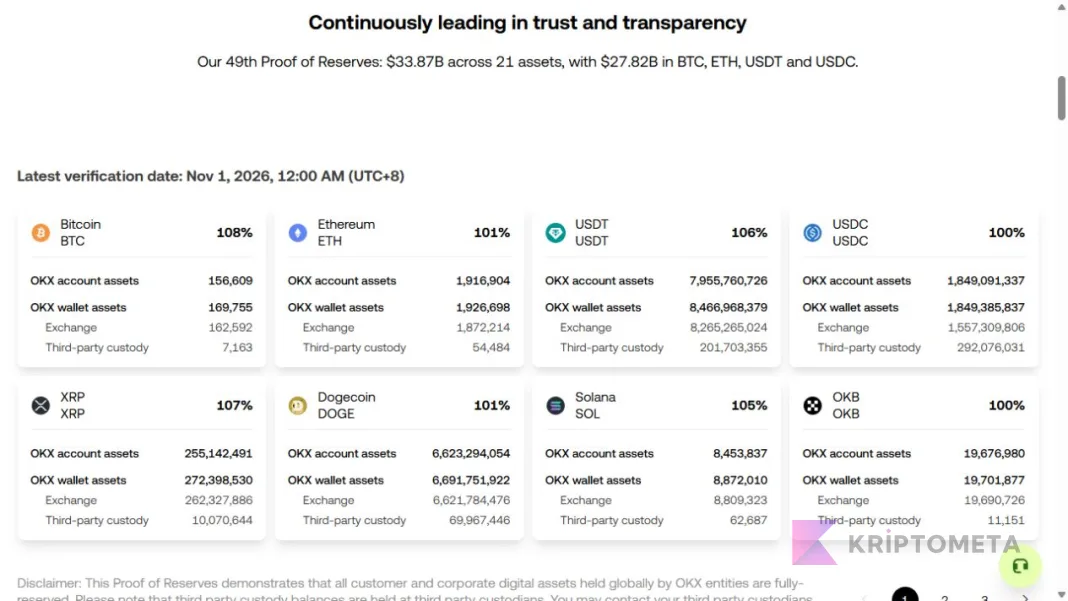
Captured November 29; the underlying verification date is November 1, 2026. Access date and data date are separate.
Read the report date, supported assets, balance inclusion and wallet totals in that order. Evaluating all corporate liabilities and operating conditions requires broader financial information. The useful role of PoR is to make a defined reserve snapshot inspectable; keep price performance and withdrawal operations as separate questions.
When Binance or Coinbase deserves a closer look
Our Binance review is the relevant comparison for a broad trading toolkit where Binance's global service is available. Its standard global spot schedule lists Regular rates of 0.10% maker/taker, or 0.075% with eligible BNB fee payment. Holding BNB introduces separate asset exposure. Compare the order type and discount requirements you will actually use, rather than declaring a winner from one rate. Binance Global and Binance.US are distinct services.
Our Coinbase review is useful for readers already using a supported Coinbase account and considering an order-book workflow. Coinbase Advanced directs users to their signed-in account for current tiers. Compare that preview with OKX's local tariff, including the route used to fund and withdraw. A universal Coinbase fee copied from a different product is a poor benchmark.
Use our crypto exchange comparison to narrow the shortlist by access, custody and total cost. For a new account, start with secure sign-in and understand one spot purchase and one withdrawal workflow before adding complex products.
Before funding the account, follow our 2FA and passkey setup guide to establish daily sign-in and an independent recovery route. Verify backup access alongside the primary method.