













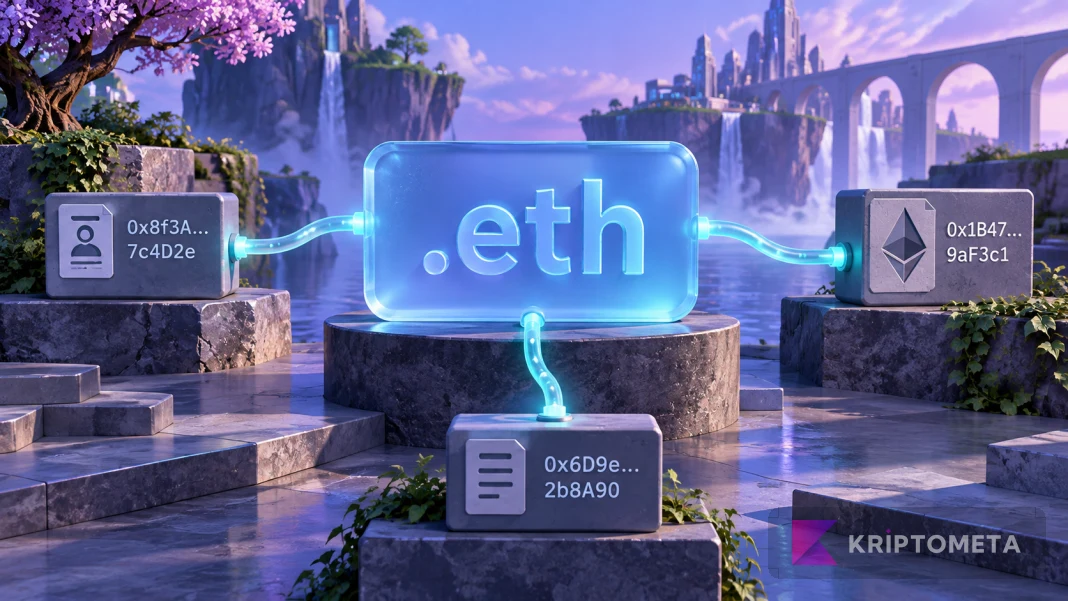
Our ENS review looks beyond choosing a .eth name: annual registration costs, network fees, expiry dates and address controls. Screens from the official app show both the convenience of readable names and the maintenance they require.
A readable name is easier to share than a long wallet address. The harder questions come afterwards: where does it point, who can change it, and when does the registration end? We assessed ENS as an ongoing naming tool, rather than judging it by the search box alone.
The KriptoMeta editorial team inspected the public screens of the official ENS app on September 26, 2026. We searched for a name, changed the pricing display and checked the public ens.eth ownership record. We did not connect a wallet, purchase a registration, sign a transaction or conduct a security audit. The ENSv2 test environment is outside this review.
Name search is straightforward; the result still needs interpretation
Searching for the illustrative name editorial-demo-2026.eth opened a registration screen. Duration and estimated costs were visible before connecting a wallet. That is a useful design choice: a visitor can assess the name and budget before preparing a payment.
Searching for the registered name ens.eth instead opened Profile, Records, Ownership and Subnames tabs. The same search field serves two different jobs: registration preparation for an available name, and inspection of an existing record. An available result does not reserve the name for the person viewing it.
New to the concept? Our ENS definition explains the relationship between a name and a wallet address. Here, the focus is on how the app presents and manages that relationship.
ENS registration costs: annual fees and gas are separate
The USD display quoted $5 for one year, an estimated $0.08 network fee and an estimated total of $5.08. The screenshot records one observation, not a fixed gas price or a quote for a later transaction. Small fees can be less apparent in the rounded ETH display, so comparing both views helps.
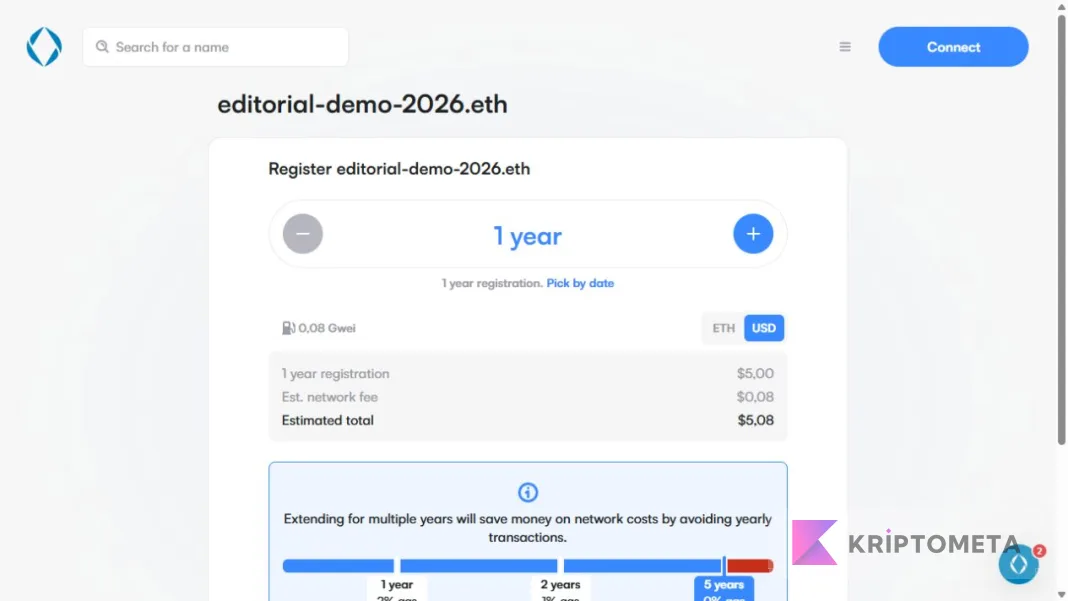
Actual ENS screen captured on September 26, 2026. Read the duration first, then the registration and network charges. The total combines those estimates; it is not proof of a completed payment. The browser used Turkish number formatting.
| Name length | Annual fee |
|---|---|
| 5 or more characters | $5 |
| 4 characters | $160 |
| 3 characters | $640 |
The official fee schedule counts the name before .eth. Fees are denominated in dollars and paid in ETH. Secondary-market prices and temporary premiums on expired names are separate from these standard charges.
You can calculate an ETH–dollar conversion for a different budget; the final ETH quote and gas charge in the registration screen still need separate checks.
One year or several?
Under the same standard tariff, three years for a five-character name would cost 3 × $5 = $15 before gas. Registering several years together can reduce the need for later renewal transactions; it does not remove the annual charge. The trade-off is paying upfront for a name you might stop using.
A shorter term lowers the initial commitment. A longer one reduces renewal administration. Deciding how often you will use the name is more useful than choosing the smallest number on screen. Our gas fee tool can help put network costs in context, but its estimate does not replace the wallet's final transaction quote.
Opening registration does not make you the owner
The ENS registration guide describes the classic mainnet process as an initial transaction, a wait of at least 60 seconds, and the registration transaction. The first step alone does not confer ownership. A name should not be treated as acquired before registration completes.
Showing a budget early is helpful, but the wallet request still needs a fresh check. The network, spelling, duration and requested total should describe the intended registration. A wallet such as MetaMask provides the signing layer; ENS supplies the naming interface. Connecting the two does not mean approving every subsequent request.
Why Owner, Manager and ETH record are different
On the ens.eth Ownership tab, Owner and Manager appeared under the same shortened address, while ETH record appeared beside wallet.ensdao.eth. The screen offers a concrete example of management and recipient records being different. These are public records, not addresses we recommend sending money to.
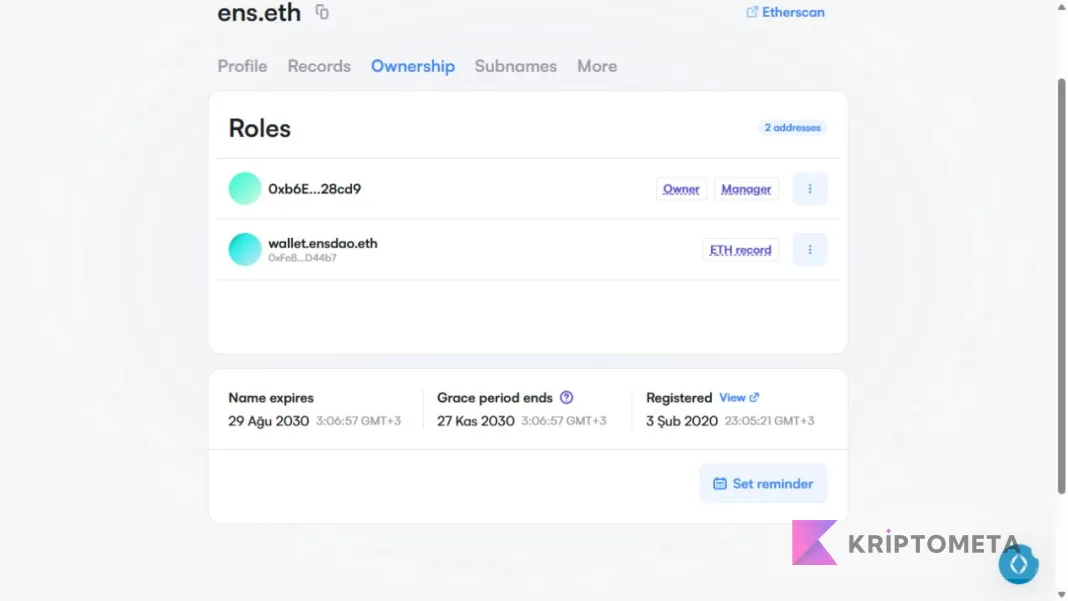
Actual ownership screen. Roles and the ETH record are in the upper card; expiry and grace-period dates are below. Identifying the name's owner is not the same task as checking its payment destination. Dates follow the capture browser's Turkish locale.
The official role explanation distinguishes ownership, record management and the ETH destination address. Wrapped names can present roles differently; do not assume every name must show three separate controls.
The practical question is: “Am I changing who manages the name, or where it points?” Treating a management change as proof that the recipient record changed would leave an unchecked assumption. Read the relevant record again afterwards. An attractive profile image or linked social account should not be mistaken for identity verification, either.
Expiry tracking and primary names have different jobs
The record we inspected displayed August 29, 2030 under Name expires and November 27, 2030 under Grace period ends. Showing both dates is useful. Treating the later date as the normal renewal deadline, however, leaves less room to deal with mistakes.
The 90-day grace period preserves the opportunity to renew. Added time runs from the old expiry date. If a renewal is late, check that the resulting expiry has actually moved into the future; setting a reminder does not renew the name.
Owning a name and displaying it as an account label are also separate tasks. A primary name setting associates the appropriate address with its chosen name. Supporting apps can show it, but support and update timing vary between services.
Who benefits from ENS, and who may not need it?
| Task | Assessment |
|---|---|
| Researching names and budgets | Access to duration and pricing before connecting a wallet is a practical advantage. |
| Inspecting public records | Profile, address and ownership views are useful; visibility alone does not establish trust. |
| Keeping a name over several years | Renewal dates and destination records require continuing attention. |
| Trading the ENS token | The naming app does not replace exchange access or investment research. |
Someone who frequently shares an address or wants a consistent name across compatible Web3 apps may find ENS useful. Someone making occasional transfers with an adequate address book may have little reason to take on registration and renewal work. Public-profile use also deserves a separate privacy decision.
Our strongest impression is that the app makes costs and management data inspectable. Its limitation is that a short name does not remove the owner's responsibility. Incorrect records, missed dates and inappropriate signatures are not solved by readability. Evaluate the actual use case, ongoing cost and maintenance habits together before deciding whether the convenience is worthwhile.
